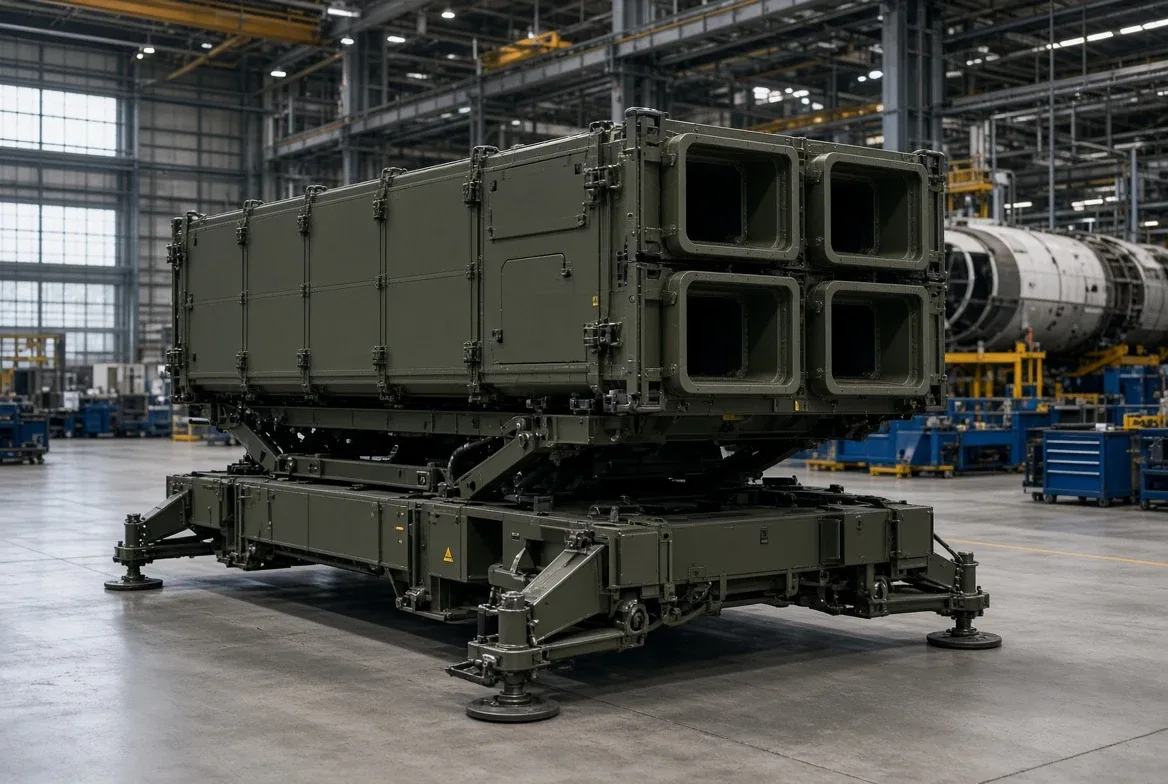
Lockheed Martin and the U.S. government have agreed to more than triple annual production of the PAC-3 Missile Segment Enhancement interceptor, from roughly 600 units a year to a target of 2,000 by the end of 2030, under a seven-year framework agreement the company describes as a first-of-its-kind approach to acquisition, according to Lockheed Martin's own announcement of the deal. The number that matters most in that plan is not the assembly line's speed but the supplier network behind it.
PAC-3 MSE is the interceptor the Patriot air and missile defense system fires to hit incoming ballistic missiles, cruise missiles, and aircraft with a hit-to-kill warhead rather than a blast fragmentation charge. It is the newest and longest-range member of the PAC-3 family, and it is the round the U.S. Army and more than a dozen allied Patriot operators have been buying in the largest numbers since Russia's 2022 invasion of Ukraine sharpened demand for layered air defense.
What exactly did the Pentagon and Lockheed Martin agree to?
The framework agreement, signed January 6, 2026 under the Department of War's Acquisition Transformation Strategy, sets a seven-year path to grow PAC-3 MSE output from about 600 missiles delivered in 2025 to 2,000 a year, Lockheed Martin's announcement of the framework agreement states. It followed with a concrete funding step on April 10, 2026, when the government issued Lockheed Martin a $4.7 billion undefinitized contract action to begin accelerating that production, the Army's own account of the award confirms. An undefinitized contract action lets work start, and money flow to a contractor, before every price and term of the eventual firm contract is finalized — a mechanism the Pentagon uses when the schedule risk of waiting for a fully negotiated deal outweighs the financial risk of starting early.
Lockheed Martin says the 2025 baseline of 620 deliveries was itself a 20 percent increase over the prior year, part of a run of incremental growth the company is now trying to turn into a much steeper curve.
Why can't Lockheed just build more missiles faster?
Because a missile's final assembly line is rarely the bottleneck; the parts that feed it are. PAC-3 MSE's seeker, its solid rocket motor, its guidance electronics, and its warhead each come from a different tier of subcontractors, many of them small, specialized manufacturers who cannot simply hire more workers and triple their own output on demand. Expanding capacity at that level means new tooling, qualified new floor space, and in some cases new suppliers altogether, all of which take years to bring online and certify for a weapon whose failure tolerance is close to zero.
That is why the framework agreement is built around seven-year subcontracts rather than a single annual order. Locking in demand that far out is what lets a small motor-casting supplier justify building a second furnace, because it knows the government will still be buying at the higher rate years from now. Breaking Defense reported that the arrangement includes inflation adjustments for those supplier contracts and a requirement that the government reimburse nonrecurring engineering costs if terms later change, a structure meant to protect suppliers' cash flow enough that they will actually spend on expansion rather than wait to see if the demand is real.
What is a seven-year framework agreement actually for?
A framework agreement is not a purchase order. It is a shared commitment on price behavior, cost sharing, and production targets that both sides use to plan investment before a specific annual buy is negotiated. Lockheed Martin describes its version of the deal as a collaborative financing model designed to preserve cash neutrality at the outset, meaning the company is not expected to front the full cost of new capacity before government funding catches up. The April contract action, by comparison, is where the money actually starts moving: it is the mechanism that lets Lockheed Martin begin placing the long-lead orders with its own suppliers that the framework's targets assume.
Defense Secretary Pete Hegseth framed the broader approach around predictability rather than urgency, saying, as quoted by Breaking Defense, that the department will "give longer, larger, more predictable contracts to companies that deliver on time and on budget." That is the trade at the center of the deal: the government accepts a multi-year commitment in exchange for a contractor willing to spend now on capacity it will not fully need for years.
Who is actually driving the demand behind this?
Patriot is fielded by the U.S. Army and, per Lockheed Martin's account, by allies and partner nations that have expanded their own orders since 2022. Publicly available sources reviewed for this article do not provide a country-by-country breakdown of current PAC-3 MSE backorders, so the precise size of the foreign order book cannot be stated here with confidence. What is established is the direction: replenishment needs from wartime interceptor use, new Patriot buyers entering the program, and existing operators topping off stockpiles have combined to push demand well above the roughly 600-a-year rate the supply chain was built to sustain.
What happens if the ramp misses its target?
Nothing in the publicly available record commits either party to a penalty if the 2,000-a-year target slips, and multi-year industrial ramps of this kind — new tooling, new qualified suppliers, new hires trained to build a precision weapon — routinely run behind their original schedules even when funding arrives on time. The honest reading of the current record is that Lockheed Martin and the Department of War have set a target and put a funding mechanism behind it; whether the supplier base can actually execute a more-than-threefold increase by 2030 is not something official documents released so far allow an outside observer to verify.
Frequently asked questions
- Is PAC-3 MSE the same as the older PAC-3 CRI interceptor? No. MSE is a longer-range, larger-motor variant of the PAC-3 family with its own separate production line, distinct from the earlier Cost Reduction Initiative round.
- Does the $4.7 billion cover the full ramp to 2,000 missiles a year? The Army's announcement of the April 2026 contract action does not state that the $4.7 billion figure represents the full cost of reaching the 2,000-unit target; it describes the award as funding to begin accelerating production under the broader seven-year framework.
- Why does an undefinitized contract action matter here? It lets Lockheed Martin and its suppliers start spending against the higher production target immediately, rather than waiting the months or years a fully priced contract can take to negotiate, at the cost of some financial terms being settled later.
For a related airdefense perspective, read Putting an Army interceptor on Navy destroyers is really about magazine depth.