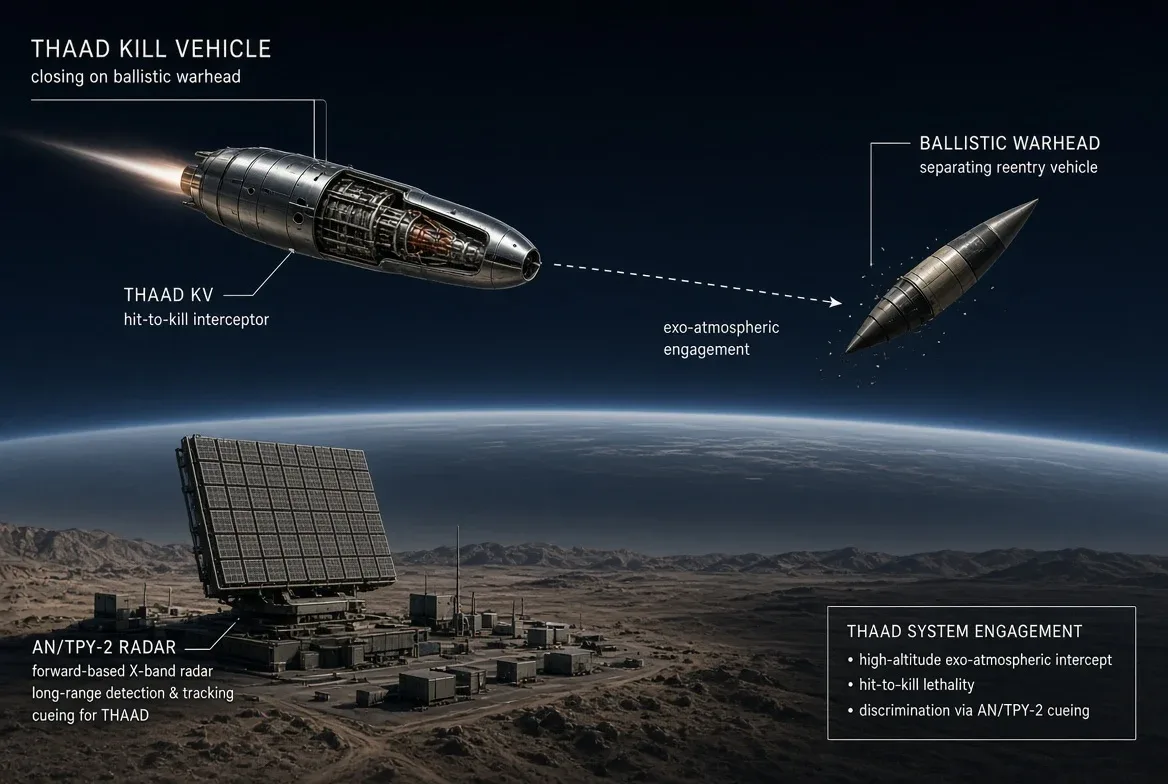
THAAD destroys an incoming ballistic warhead the way a bullet stops another bullet: by colliding with it head-on at hypersonic speed, with no explosive charge at all. That is the Missile Defense Agency's own description of the system's hit-to-kill design, which the agency credits with a run of successful intercept tests. The harder problem now, according to a Missile Defense Project analysis reported by Breaking Defense, is that the United States has too few of those interceptors left to keep refilling the magazine.
How does a kill vehicle destroy a warhead without an explosive charge?
Terminal High Altitude Area Defense, or THAAD, is a mobile, land-based system built to intercept short- and medium-range ballistic missiles in their terminal phase, the final seconds of flight as a warhead descends toward its target. The Missile Defense Agency describes the interceptor's kill vehicle as using "hit-to-kill technology whereby kinetic energy destroys the incoming warhead" — no fragmentation charge, no proximity fuze detonation, just mass meeting mass at closing speeds that turn the collision itself into the lethal mechanism.
That single design choice is why THAAD's test record matters so much to how the system is judged. Lockheed Martin, the interceptor's manufacturer, states on its own product page that THAAD has posted a "100% flight test intercept success rate," a manufacturer's claimed figure rather than an independently audited one. The Missile Defense Agency separately states the program has recorded "17 successful intercepts in 17 attempts" since testing began, including what it describes as the first combat intercept by any nation, when the United Arab Emirates used THAAD to engage ballistic missiles in January 2022.
What does the radar actually see before the intercept happens?
Hit-to-kill only works if the interceptor knows exactly where the warhead will be at the moment of collision, which is the job of the AN/TPY-2 radar, described by the Missile Defense Agency as the largest air-transportable X-band radar in the world. The radar performs search, tracking and discrimination — separating the actual warhead from decoys, debris and the spent rocket body — then feeds real-time targeting data to the interceptor through the battery's fire control component, which the agency calls the system's "communications and data-management backbone."
A THAAD battery's launchers each carry eight interceptors and can reload quickly, but a launcher is only as useful as the radar and fire-control loop steering it. The engagement chain runs in a fixed sequence:
- The AN/TPY-2 radar detects and tracks an inbound ballistic target.
- The radar discriminates the actual warhead from decoys and debris.
- The fire control system computes an intercept solution and cues a launcher.
- The interceptor's booster carries the kill vehicle out of the atmosphere or to high altitude within it.
- The kill vehicle's own seeker takes over for final homing.
- The kill vehicle collides with the warhead, destroying it by kinetic force alone.
How many THAAD interceptors does the United States actually have right now?
The Missile Defense Agency states it had delivered 799 THAAD interceptors in total as of October 2023, across a program that has procured eight batteries — seven fielded to the US Army, one still in production. But total deliveries are not the same as ready stock. Analysts at the Center for Strategic and International Studies, cited by Breaking Defense, assessed that roughly 534 interceptors were available before June 2025, with about 384 assigned to the eight batteries' launchers and around 150 held as spare inventory.
That spare pool is the part that matters for any new contingency, since deployed interceptors are not available to surge elsewhere without pulling a battery off its existing mission.
Why did the Israel-Iran conflict deplete the stockpile?
In June 2025, US forces used THAAD batteries to help defend Israel during its conflict with Iran. CSIS analysts, as reported by Breaking Defense, assessed that US forces fired somewhere between 100 and 250 THAAD interceptors in that defense — a wide range that reflects how contested and hard to verify wartime expenditure figures are, even when the assessment comes from a respected think tank rather than an anonymous claim. Missile Defense Project analyst Tom Karako was quoted by Breaking Defense saying of the pace of use, "Now we're doing it so frequently, we're afraid" supplies are insufficient.
Even at the low end of that range, the expenditure consumed a third or more of the roughly 150-interceptor spare inventory in a single conflict, according to the CSIS assessment — leaving the reserve thinner heading into any subsequent crisis, whether in the Middle East or elsewhere.
Why can't production simply catch up?
Breaking Defense reported that missiles the Pentagon ordered as far back as fiscal year 2021 have still not been delivered, and that the Missile Defense Agency does not expect new THAAD interceptors until April 2027 — a gap CSIS's Wes Rumbaugh described, per the same report, as running from July 2023 to April 2027. Two structural problems drive that delay, according to Breaking Defense's reporting: budget uncertainty that discourages the interceptor's suppliers from investing in sustained production capacity, and a production line that cannot reliably scale up without consistent government orders to plan against.
There is also an allocation problem layered on top of the manufacturing one. THAAD is not a US-only program — the United Arab Emirates and Saudi Arabia both operate batteries, according to Lockheed Martin, and both are scheduled recipients of interceptors from the same production line. Prioritizing US Army orders ahead of allied deliveries risks straining those relationships at the same time the Pentagon is trying to expand THAAD's manufacturing base, including recent contract actions aimed at increasing rocket-motor production for the interceptor.
What does the shortage actually change?
None of this affects what a fielded THAAD battery can do in a single engagement — the hit-to-kill physics and the AN/TPY-2's targeting chain are unchanged by how many interceptors sit in the warehouse. What changes is what happens after the first sustained use. A battery that fires through its assigned load in an intense defense of one theater has, by definition, fewer interceptors to reload with until the production line closes the gap CSIS describes running into 2027. That is the actual trade the interceptor shortage represents: not a weaker intercept on any single shot, but a thinner cushion for whatever comes next.
For a related procurement perspective, read Here is how the Pentagon actually processes an ally's request to buy US weapons.