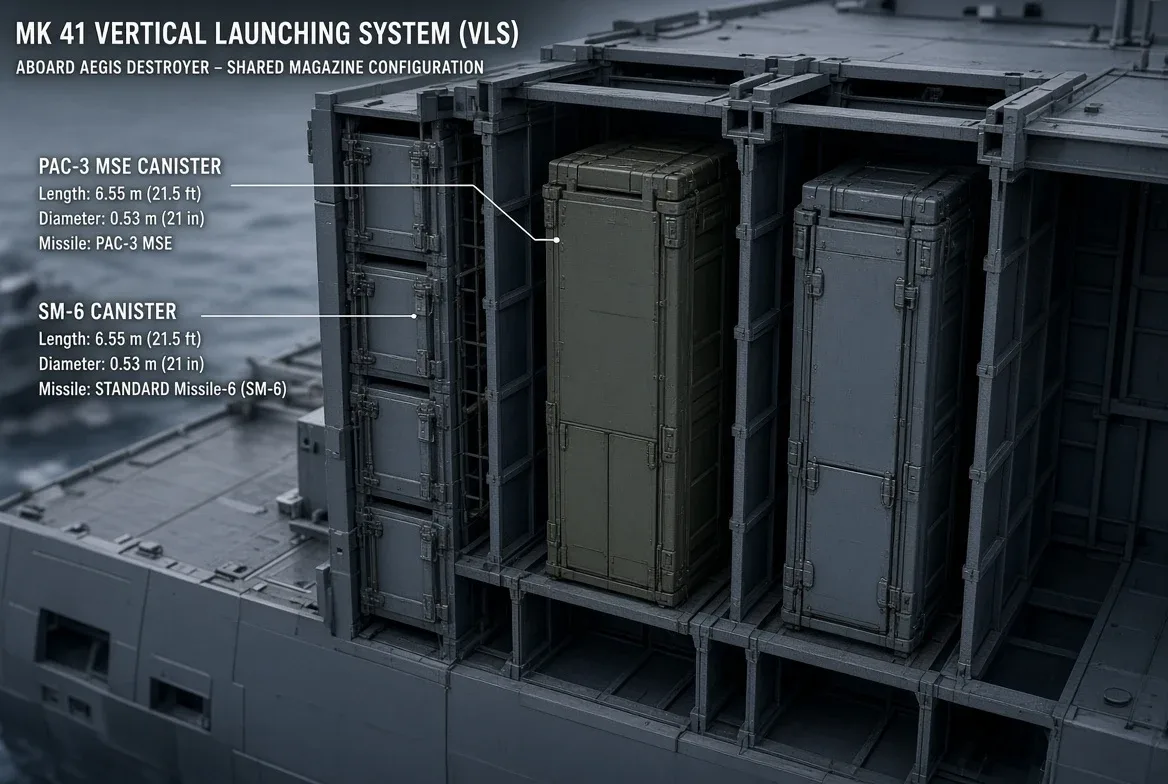
The U.S. Navy has cleared Lockheed Martin's PAC-3 Missile Segment Enhancement (MSE) interceptor, built for the Army's Patriot air defense system, to fire from the Mark 41 Vertical Launching System aboard Aegis destroyers and cruisers. Lockheed Martin announced the integration at the Navy League's Sea-Air-Space symposium in National Harbor, Maryland, on April 23, 2026, according to USNI News. The interceptor itself is not new and does not gain a new target set by changing launch platforms; what changes is which magazine it draws from, and how fast that magazine can be refilled.
What did the Navy actually announce?
Per USNI News' report on the Sea-Air-Space announcement, Lockheed Martin said PAC-3 MSE integration with the Mark 41 VLS and the Aegis Combat System is now finalized, making the Army's hit-to-kill interceptor launchable from Arleigh Burke-class destroyers and Ticonderoga-class cruisers. The Navy has requested 405 PAC-3 MSE missiles in its fiscal year 2027 budget request, the same report states. USNI News attributed the move to sustained high-tempo air defense operations in the Middle East and to concern over Chinese and Russian ballistic and hypersonic anti-ship threats in the Indo-Pacific, without detailing a specific new threat the missile addresses that it could not already address for the Army.
What is the PAC-3 MSE, and what can it already do?
The PAC-3 MSE is a hit-to-kill interceptor: it destroys its target through direct kinetic impact rather than a proximity-fused warhead, a design Lockheed Martin describes on its own product page as "Hit-to-Kill missile technology." The manufacturer's page states the missile has logged more than 100 successful flight tests, that more than 2,500 PAC-3 MSEs have been produced, and that the interceptor is fielded by 17 partner nations — figures that are the manufacturer's own claims about its product, not independently verified test results. Lockheed Martin also describes the missile as "combat proven against ballistic and cruise missiles, as well as hypersonic and airborne threats," a characterization USNI News reported the company repeating at the Sea-Air-Space rollout; that phrase is Lockheed Martin's own claim, not an independent assessment.
An earlier account from TWZ, published when the MSE variant entered full-rate production in January 2018, described the missile's core upgrades over the original PAC-3: a larger dual-pulse solid rocket motor, larger control fins, and upgraded actuators and thermal batteries intended to extend the interceptor's reach and expand its performance envelope in altitude, though TWZ noted specific range and altitude figures for the type remain classified. The same TWZ report noted the Army's own launcher can be configured to carry twelve MSE canisters, or a mixed load of six MSEs plus two four-packs of the older PAC-3 — evidence, in the Army context, that the MSE variant was designed from the outset to be a comparatively compact, dense-packing round rather than a single oversized effector.
Why does the Aegis Combat System matter here?
USNI News' report names the Aegis Combat System as the naval air defense backbone into which PAC-3 MSE is being integrated, alongside RTX-built SM-2 and SM-6 interceptors that already fire from the same Mark 41 cells. What the report does not describe — and what has not been laid out in any publicly available document reviewed for this piece — is how PAC-3 MSE's own active radar seeker and terminal guidance will be cued and fused with Aegis' AN/SPY-family radar and fire-control loop, which was built around SM-2/SM-6 engagement geometry. Publicly available sources do not establish that architecture; readers should treat any claim about the exact sensor-to-shooter sequence for a shipboard PAC-3 MSE shot as unconfirmed until the Navy or Lockheed Martin publishes it.
Why is this about magazines, not missiles?
The clearest evidence for a capacity story, rather than a capability story, sits in the production numbers USNI News reported: PAC-3 MSE output is ramping from 600 to 2,000 units a year under a seven-year production deal Lockheed Martin signed in January 2026, versus a projected SM-6 production rate of roughly 500 units a year. A Mark 41 cell is a fixed, finite resource per hull — every cell loaded with one interceptor type cannot also hold another — so a faster-building, lower-tier round that can share those same cells effectively grows the number of engagements a strike group can absorb before its magazines run dry, independent of whether SM-6 production keeps pace.
| Interceptor | Reported annual production rate | Primary source |
|---|---|---|
| PAC-3 MSE (Lockheed Martin) | Ramping from 600 to 2,000 units/year, per a seven-year deal signed January 2026 | USNI News, April 23, 2026 |
| SM-6 (RTX) | Projected at roughly 500 units/year | USNI News, April 23, 2026 |
That gap is the mechanism behind the "magazines, not missiles" reading of this integration. Adding a second, faster-building interceptor family to the same VLS cells is a hedge against a single supplier's production line becoming the limiting factor in how many engagements a destroyer can fight, a concern USNI News tied directly to "high-tempo air defense operations" already under way in the Middle East.
What does reloading at sea have to do with it?
A Mark 41 cell that has fired its interceptor stays empty until the ship returns to a pier equipped to reload it — current doctrine still assumes shore-based rearming, and at-sea reload remains an experimental capability. USNI News reported on July 23, 2025, that the Navy successfully reloaded VLS canisters aboard the destroyer USS Farragut from the support ship USNS Gopher State while anchored off the Virginia coast, following earlier 2024 trials using a mechanism called the Transferrable Rearming Mechanism. Rear Adm. Charles Kirol, commander of Navy Expeditionary Logistics Support Group, called the test "a significant milestone in the Navy's ability to evolve and maintain our warfighting advantage," per that report, which also noted the trials were driven by concern that adversaries would target port infrastructure early in a conflict and that ships in the Red Sea were already expending missiles at a high rate.
Put together, the sequence reported across these sources reads less as "PAC-3 MSE gives the Navy a capability it lacked" and more as "the Navy is diversifying which interceptor fills a cell it may not be able to refill quickly." That is the whole trade.
FAQ
What is the PAC-3 MSE interceptor? It is Lockheed Martin's enhanced Patriot Advanced Capability-3 missile, a hit-to-kill interceptor that destroys targets by direct kinetic impact. The manufacturer states it has logged more than 100 successful flight tests and that over 2,500 units have been produced, per its own product page.
Why can a Navy destroyer now fire an Army missile? Lockheed Martin announced in April 2026 that PAC-3 MSE has been integrated with the Mark 41 Vertical Launching System and Aegis Combat System used on Navy destroyers and cruisers, according to USNI News, sharing launch cells previously limited to RTX's SM-2 and SM-6.
How many PAC-3 MSE missiles is the Navy buying? The Navy requested 405 PAC-3 MSE missiles in its fiscal year 2027 budget request, USNI News reported, as part of a broader production ramp from 600 to 2,000 units a year under a deal Lockheed Martin signed in January 2026.
Can Navy ships reload their missile cells at sea yet? Only experimentally. USNI News reported a successful test reloading VLS canisters on the destroyer USS Farragut from a support ship in July 2025, following 2024 trials, but shore-based rearming remains the standard practice.
For a related business news perspective, read Lockheed's plan to triple Patriot interceptor output by 2030 hinges on parts, not the assembly line.