An engagement zone is the volume of airspace in which a specific fire unit can complete an entire intercept chain — detection, tracking, decision, launch, guidance, and kill — against a defined type of target. The missile's advertised reach is only one wall of that box. Lockheed Martin's published materials describe the PAC-3 MSE interceptor as engaging ballistic targets out to roughly 120 kilometers, a manufacturer claim with no open-source test data behind it, yet the zone a Patriot battery actually defends is sized by geometry, timing, and kill probability, not by a datasheet number.
The gap between how far a missile can fly and where an engagement is worth attempting is one of the least understood things in public air-defense discussion. This piece takes the box apart wall by wall. EDN News 12 is an online publication, not a broadcaster, and it drafts from open sources only: official documents, manufacturer statements, and named published analyses.
What exactly does an engagement zone describe?
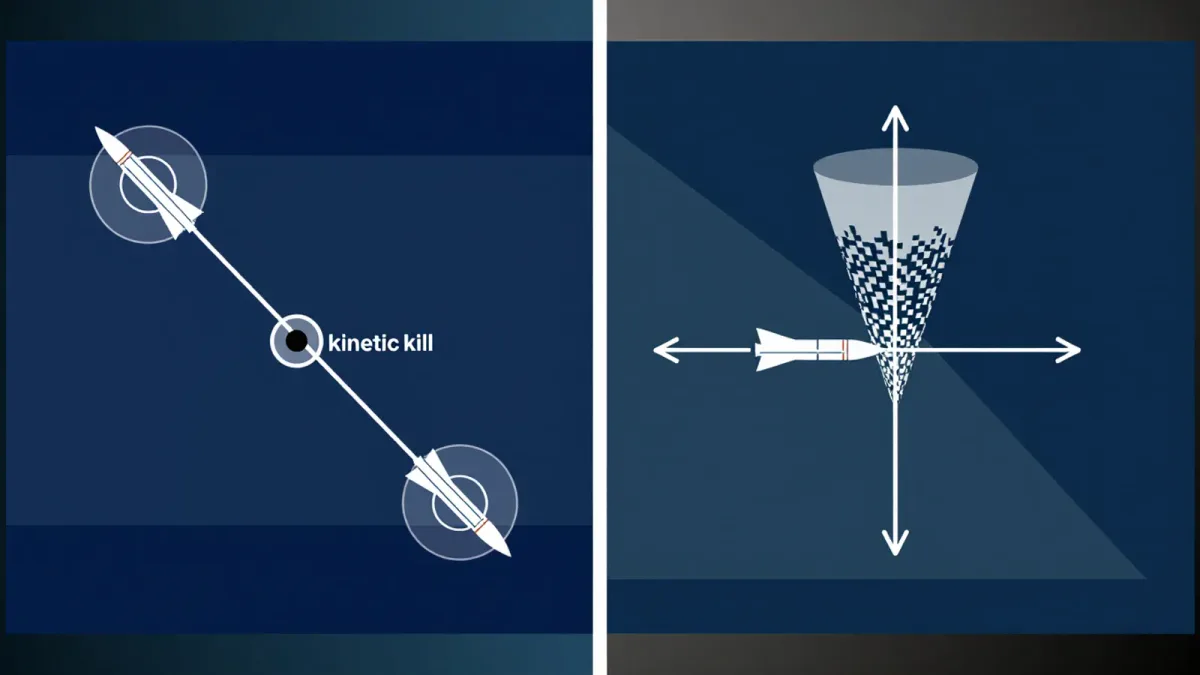
The zone is a three-dimensional volume, usually drawn in planning documents as a wedge or funnel extending out from the launcher. Practitioners distinguish several boxes that sit inside one another. The weapon engagement zone (WEZ) is where the missile can physically reach and maneuver against a target of a given speed and aspect. The fighter engagement zone (FEZ) is the same idea applied to aircraft guns and air-to-air missiles. The missile engagement zone (MEZ) is the surface-to-air version. Inside the WEZ sits a smaller, better box: the range band where the engagement is not merely possible but probable, where the interceptor arrives with enough energy, the seeker has enough time, and the fuse geometry works.
Documents that discuss these zones almost always carry caveats, and they should. Exact WEZ boundaries for fielded systems are classified in essentially every armed service. What open sources establish is the shape of the problem and the factors that move the edges — not the precise numbers for any given battery on any given day.
What sets the far edge of the zone?
Range is not one number; it is a family of numbers that collapse toward the worst case. The interceptor's motor burns out early in flight, and everything after burnout is a trade between remaining energy and maneuver. A tail-aspect shot against a departing target preserves energy; a high-aspect shot against an incoming one spends it fast. A crossing target forces the interceptor to pull hard lateral G, and every G pulled bleeds speed. Add a target maneuvering at the last seconds and the kinematic reach shrinks again.
Then comes probability of kill, which planners treat as part of range, not a separate topic. Standard defense-planning literature — RAND's work on missile defense engagement is one published example — emphasizes that a defender sizes salvos and engagement ranges around the probability that a single intercept succeeds, which pushes the practical engagement window earlier and closer than pure kinematics would suggest. The far edge of the real zone is therefore wherever the shot stops being worth the rounds, well inside where the missile could still physically arrive.
Why does the near edge matter as much as the far one?
Every engagement zone has a minimum range, and it exists for mechanical reasons. The missile needs flight time to arm its safety systems, the seeker needs time to settle on the target, and the fire-control radar needs enough track history to predict an intercept point. Against a fast, low target, those seconds translate into kilometers. A target that pops up at short range can be inside the launcher's minimum range before the system has a valid firing solution — physically surrounded by the zone, yet unengageable.
That is why defenders overlap zones rather than stacking them. A short-range gun or point-defense missile, such as the 20mm C-RAM system the U.S. Army fields against rockets, artillery, and mortars, exists precisely to cover the near field where a longer-range interceptor cannot yet have armed and maneuvered. The layering is not abundance; it is the near edge of one zone mating with the far edge of the next.
How do altitude limits close the box?
The zone is also bounded above and below. The ceiling comes from interceptor energy and guidance geometry — a ballistic target at high altitude must be met while both bodies are still maneuverable. The floor is often the harder constraint: against terrain-hugging cruise missiles or drones, the radar horizon itself, not the missile, may set the limit, because the target is below the radar's line of sight until it is close. Standard radar engineering references give a horizon of roughly 4.12 kilometers times the square root of antenna height in meters — about 23 kilometers for a 30-meter mast — which is why low-altitude zones are narrow wedges close to the battery.
Different missiles in one family can occupy different boxes. Open Western air-defense literature has long described the Patriot family as carrying one interceptor type optimized for ballistic targets at high altitude and another for air-breathing targets at lower altitude. One battery, several overlapping zones, each sized for its own threat set.
How does a defender actually size the zone?
- Define the threat set. Speed, altitude, aspect, and maneuver level of the expected targets — a supersonic cruise missile compresses every edge of the box compared with a slow drone.
- Apply the firing tables. The manufacturer's and the service's engagement-planning data convert interceptor kinematics into launch envelopes for each threat class. These documents are classified; their existence and logic are not.
- Subtract the radar horizon. The antenna's height and local terrain cut the detectable volume before the missile's reach is even considered.
- Account for command policy. Rules of engagement, identification requirements, and fratricide-avoidance geometry — IFF interrogation is its own gate — shrink the zone where friendly traffic or ground forces complicate the shot.
- Layer the defenses. What remains after all of the above is cross-checked against neighboring units so that one unit's near field is another's far field.
The published range figures sit at the start of this process, not the end. They are inputs.
What moves the zone day to day?
The same battery, at the same site, does not defend the same box on consecutive days. The drivers are mundane and worth listing as a table, because every one of them is more influential than the difference between two competing manufacturer range claims.
| Driver | Effect on the zone |
|---|---|
| Target aspect and speed | Closing targets deepen the far edge; crossing and receding targets shrink it |
| Target altitude | Low targets run into the radar horizon long before the missile's limits |
| Rules of engagement | Identification and safety corridors cut whole sectors out of the box |
| Weather and clutter | Anomalous propagation and ground clutter raise the effective detection floor |
| Salvo policy | Higher intercept probability per target means earlier, wider engagement windows |
Read any engagement this way and the datasheet numbers become what they always were: the starting outline that terrain, timing, and policy cut down into the zone that actually exists. That is the whole trade — the box is never as big as the brochure.