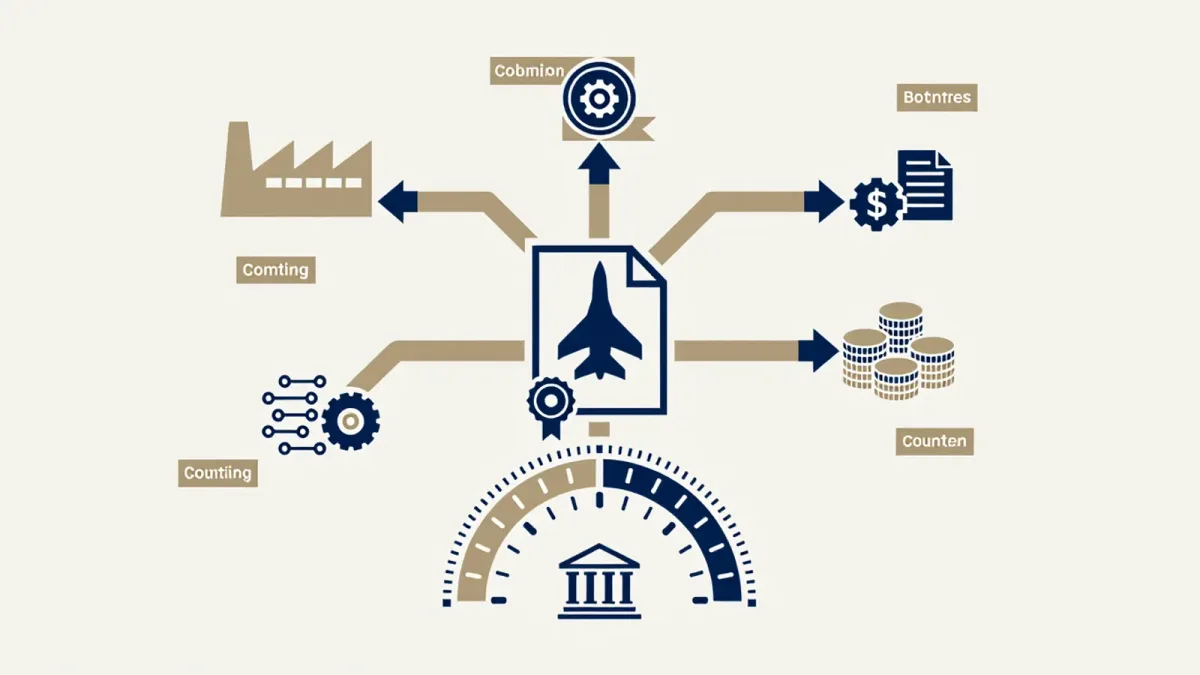
An offset is the legal thing: a written obligation, accepted by the exporter under the import contract, to return economic value to the buying country and account for it against a negotiated credit target — with Commerce Department reporting showing obligations at or above 100 percent of contract value. Industrial participation is the political label governments paste on the same paperwork.
The distinction sounds like semantics until you read a deal announcement. One ministry praises "industrial participation" worth billions; the actual document is an offset agreement with categories, banking rules and a completion deadline, enforceable through penalties. EDN News 12 is an online publication, not a broadcaster, and this explainer is drafting from open-source material only — public statistics and published statute language — because the individual packages themselves are confidential.
What exactly is an offset?
In United States practice, the term is defined in the Arms Export Control Act and tracked by the Commerce Department's Bureau of Industry and Security, which reports to Congress under Section 36(b) of that statute. The working definition: an offset is an agreement to offset — to compensate the buying government for the cost of the purchase through exports, local investment, technology transfer, purchased goods or training credits. The obligation is negotiated in parallel with the weapons sale, expressed as a percentage of contract value, and discharged over years or decades.
Three structural features separate an offset from ordinary business. First, it is conditional on the sale: no contract, no obligation. Second, it is measured — each qualifying transaction earns credits, and the ledger must close at the negotiated value. Third, it is enforceable: miss the target and the exporter owes liquidated damages or other penalties, which the sister practice of offset audits exists to police. BIS annual reports have described multi-year averages of offset values running near or above the full value of the defense contracts they attach to, in periods the bureau's published tables cover through 2023.
What does industrial participation actually mean?
Industrial participation is not a defined term in United States law; it is a policy label, and different governments define it locally. When a European or Asian ministry announces that a fighter buy carries "industrial participation worth 100 percent," it is describing the same negotiated package an American report would call an offset — work share, local assembly, supplier development — but framed as an industrial-policy outcome rather than a compensatory debt.
The phrase also covers things offsets sometimes do not. Some buyers demand guaranteed final assembly lines, sovereign ground segments for satellites, or long-term sustainment work placed with national firms, and call the whole basket industrial participation whether or not every element earns offset credit under the formal ledger. That is why the two numbers can legitimately disagree: the headline participation figure and the offset obligation in the legal documents are not always the same basket, and publicly available sources do not establish the internal composition of most national programs.
Where the two overlap, and where they split
The clean way to hold the concepts apart: industrial participation is the goal a buyer state pursues; the offset agreement is one instrument — the most instrumented one — for compelling the seller to contribute to that goal.
The overlap is largest with direct offsets. Direct offsets are credits earned through activity tied to the purchased weapon: co-production of its parts, licensed assembly of its airframe, subcontracted work on its radar. That is precisely what most buyers mean by industrial participation in a fighter program. Indirect offsets — a foreign investment, a civilian export contract, a tourism promotion — earn credits in the ledger but have nothing to do with the weapon, and few ministers would call them industrial participation in the program they were bought alongside.
| Feature | Offset agreement | Industrial participation |
|---|---|---|
| Legal status | Defined, contractual obligation with penalties | Policy label; definition varies by government |
| Measured how | Credits against a negotiated percentage of contract value | Headline figures, jobs, work-share value — no standard ledger |
| Scope | Direct and indirect credits both count | Usually only defense-industrial content |
| Enforcement | Liquidated damages, penalties, bank guarantees | Political accountability, not contract law |
| Public visibility | Aggregated in BIS reports to Congress | Announced at signings, rarely audited in public |
Why the label matters when you read a deal
Because the two words move different numbers, sloppy use manufactures phantom value. A ministry may announce industrial participation equal to the full contract while the enforceable offset obligation sits lower — or the reverse, where the offset percentage is high but much of it is indirect credit with little defense-industrial content. Neither number is false; they measure different baskets. Analysts who quote the press release rather than the obligation structure systematically overstate how much actual work lands in the buying country.
The same distinction decides who carries risk. The exporter signs up for the offset obligation and prices it in; the buying government owns the industrial-participation promise it made to its own parliament and public. When fulfillment slips — and audits reported in BIS aggregate statistics show shortfalls are a routine feature of the business — the contractual exposure lands on the exporter, while the political embarrassment lands on the buyer. Two parties, two ledgers, one announcement ceremony.
How to tell which one a document is describing
Look for the mechanics. If the text mentions percentages of contract value, credit banking, penalties for shortfall, or a compliance period, it is describing the offset agreement — the enforceable instrument. If it mentions jobs created, national suppliers selected, assembly lines opened, or technology ambitions without a credit structure, it is describing industrial participation — the policy narrative. Trade press and signing ceremonies almost always quote the second; the Commerce Department's offset reports almost always tabulate the first.
Numbers illustrate the gap. When a government announces a fighter program with "50 percent industrial participation," that figure may count the assembly hangar, the paint shop and the training syllabus; the offset obligation behind the same deal may specify far less local content, with the balance earned in indirect credit. Analysts comparing campaigns should therefore normalize on the obligation, not the announcement, before drawing any conclusion about which buyer extracted better terms — a comparison that only official aggregate reporting, where it exists, supports.
Neither source lies, but only one of them binds. The honest reading of any large fighter or missile deal starts from the enforceable obligation and treats the participation language as intent — ambitious, public and legally unanchored. That is the whole trade.