An offset agreement is a contractual commitment by a weapons exporter to route economic value back to the importing country — local production, subcontracted work, technology transfer or countertrade — beyond the weapon itself, and the scale is not marginal: the Commerce Department's Bureau of Industry and Security has reported cumulative offset agreements exceeding $130 billion since reporting began in 1993, per its annual Offset Reports to Congress under Section 36(b) of the Arms Export Control Act. For many buyers, those commitments are as decisive as the missile's advertised range.
This piece explains the mechanism: what offsets consist of, how obligations are counted and credited, and why a deal advertised as $5 billion can represent several times that in negotiated industrial content. The American framework is the best documented in open sources, so it anchors the explanation, with the caveat that most offset contract terms are confidential between buyer, seller and the two governments — publicly available sources establish the structure, not the fine print of specific deals.
What exactly does an offset consist of?
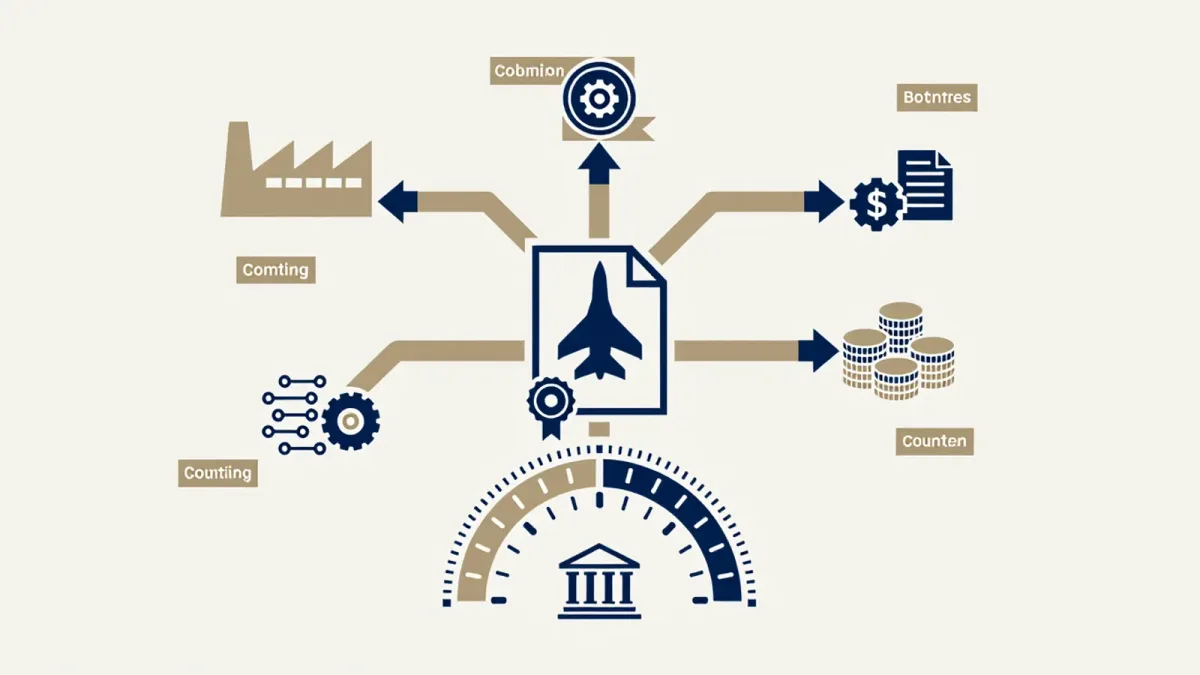
Four categories recur in every BIS report. Direct offsets tie the returned value to the weapon being sold: co-production of the airframe or missile in the buyer's country, licensed assembly lines, subcontracted components destined for that program. Indirect offsets have nothing to do with the weapon: the exporter invests in the buyer's civilian industry, buys goods, or channels unrelated business to the importing country to accumulate credit. Technology transfer — training, know-how, documentation — can appear under either heading.
The BIS taxonomy also counts countertrade arrangements, in which the exporter commits to purchase local goods of agreed value. A typical package mixes several categories, and the mix is a bargaining outcome, not a formula: an importing government that wants an industrial base gets co-production; one that wants jobs across the economy mixes in indirect credits. The weapon and the offsets are one negotiated instrument, which is why headlines that price the missile alone systematically understate what was actually traded.
How large do offset obligations get?
BIS reporting has shown multi-year averages of offset obligations running at or above 100 percent of the associated contract value in several periods — a buyer negotiating a $5 billion purchase may extract commitments of comparable or larger economic value. The reporting covers agreements by American firms above the $5 million reporting threshold, and its tables show aerospace dominating the totals, reflecting that fighters, helicopters and air defense systems are where buyer leverage is greatest.
Leverage is the operating variable. A single-source supplier selling a system the buyer cannot get elsewhere extracts mild offset terms; a competitive campaign — two fighter makers bidding against each other — produces escalating industrial promises. That dynamic explains why offset packages grew over the 1990s and 2000s as the number of credible fighter suppliers shrank but buyers demanded more: the remaining sellers competed on industrial content when they could no longer compete on choice.
How are offset credits counted?
Every unit of returned value converts into offset credits at a negotiated multiplier, and the multiplier is where deals are won. A dollar of straightforward subcontracting might earn one credit dollar; a dollar spent on hard technology transfer or local research might earn two or three, because the importer values durable capability above purchased content. The agreement defines which activities qualify, which government certifies completion, and how long the exporter has to deliver.
Banking completes the machinery. Credits earned above obligation, or credits delivered early, can be banked for later use or, in many agreements, sold to third-party companies that have offset obligations of their own — a secondary market that exists almost entirely out of public view. BIS reports acknowledge the practice; individual banked-credit transactions are confidential, and publicly available sources do not establish their aggregate size in any given year.
Who enforces offset commitments?
Enforcement runs on three layers. Contractually, the importing government holds the exporter to liquidated damages or penalty clauses negotiated into the deal — typically a percentage of the shortfall in unmet obligations. Nationally, some buyers maintain dedicated offset authorities that audit and certify performance. On the American side, BIS collects the statistics and reports to Congress, while the State Department's Directorate of Defense Trade Controls polices the arms-transfer rules that surround the agreements.
The honest limitation is visibility. Penalty amounts and defaults are negotiated confidentially, and public sources document only the rare cases that surface through litigation or consent agreements. What the record does establish is the incentive structure: because unmet obligations threaten future sales to that customer and reputational standing elsewhere, exporters treat offset fulfillment as a standing business line with dedicated management — a fact visible in the staffing that major primes maintain for offset administration.
Do offsets actually help the buyer's industry?
The economics are contested and worth stating carefully. Supporters point to real industrial outcomes: assembly lines, certified suppliers, engineers trained on modern practices. Critics, including academic reviews of offset economics, note that co-production can deliver lower-tier work while the exporter retains the profitable high-value content, and that guaranteed local content raises unit prices because small national production runs forfeit the seller's scale economies. Both things are true in different deals; the differentiator is the quality of what the buyer negotiated, not the existence of offsets.
The trap the literature most consistently documents is the fixed-cost one: a national assembly line sized for one buyer's fleet cannot survive that fleet's completion, so the buyer pays a premium during the program and inherits a facility with no follow-on workload. Offsets buy capability and jobs; they do not repeal arithmetic, and a buyer that negotiates local content without an export or follow-on plan is renting an industry rather than building one.
Why should a defense reader track offsets at all?
Because offsets predict the next program. A country that built licensed fighters under offset obligations acquires design skills, supplier certifications and a workforce — the raw material of an indigenous program a decade later. The BIS tables, read across years, show precisely this pattern in several partner nations' industrialization. The offset package in last decade's fighter deal is the leading indicator for the indigenously designed aircraft now appearing in that country's press releases.