A Letter of Acceptance, or LOA, is the signed document that turns a US government offer into a binding Foreign Military Sales case: before the buyer signs, nothing is fixed; after, prices and delivery dates change only by formal modification. The State Department reported $117.9 billion in FMS agreements for fiscal 2024 — every case rests on this one document.
The LOA is easy to mistake for a press-release moment, because headlines celebrate the signing ceremony. In practice it is the legal hinge between an offer and a case, governed by the Arms Export Control Act and administered by the Defense Security Cooperation Agency under its Security Assistance Management Manual. This explainer walks through what the document contains, what changes the moment ink dries, and why practitioners watch its validity dates the way aviators watch fuel gauges.
What does an LOA actually contain?
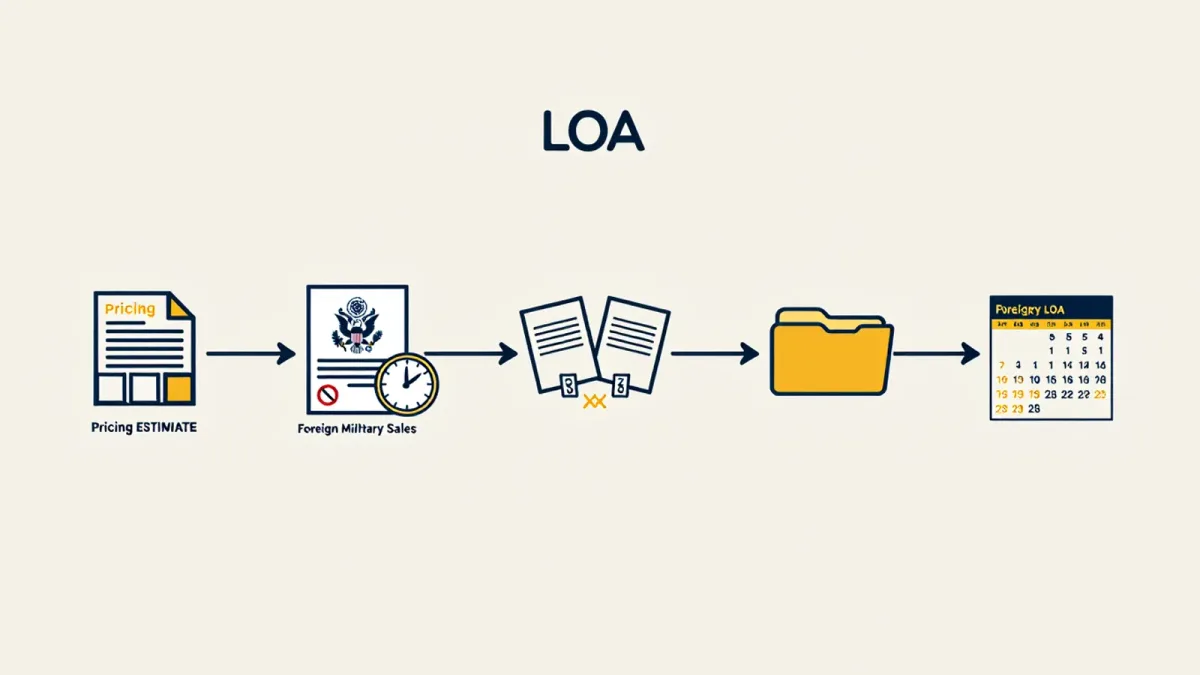
An LOA is a government-to-government offer built on a standard structure. It identifies the materiel and services — the missiles, the launchers, the training seats, the spares packages — itemized against prices drawn from a pricing estimate prepared by the supplying department. It lists the estimated delivery schedule, the points of contact, financing terms, and the standard and special terms and conditions that wrap the case, including end-use assurances.
Two administrative features matter most for schedule. The LOA carries an offer expiration date: the United States holds its pricing and availability open for a fixed period, and if the buyer does not sign in time, the offer lapses and must be refreshed against new prices. It also carries case implementation instructions that start the machinery — fund establishment, line-item activation, initial planning conferences — only after acceptance. The document is long, but its job is simple: it converts a negotiating position into a dated, numbered, priced obligation of two governments.
When does the deal actually become binding?
On return of the countersigned LOA, the case is implemented. Before that moment the buyer is free to walk away; after it, cancellation carries financial consequences, because the United States government begins obligating funds against the case lines. This is why the timing of acceptance is a genuine decision variable rather than ceremony: a buyer who signs early locks prices against future inflation, while a buyer who delays an already-signed implementation risks paying more for the same hardware — a dynamic visible across the air-defense buys of 2022 through 2024, when European governments accelerated Patriot and NASAMS cases precisely to fix prices and production slots.
Note the asymmetry with direct commercial sales, where a private contractor signs a contract with the importing government and export licensing follows separately. In the FMS construct, the buyer signs with the United States government itself, and the LOA is the instrument of that signature. Same hardware, different legal spine.
Why do validity dates matter so much?
Every FMS case line carries a validity period during which the US government commits to deliver at the agreed price. The Security Assistance Management Manual sets the framework for establishing and, when needed, extending those dates, and a case whose validity expires without delivery becomes a candidate for extension, revision or closure with a refund of unexpended funds. Practitioners care because validity is where supply-chain reality meets paperwork: an interceptor line that slips a year forces a formal decision — extend and possibly reprice, restructure the case, or close it out.
For air-defense buyers in the mid-2020s this has been a live issue, since multi-year interceptor backlogs pushed agreed delivery dates well beyond original assumptions. The mechanism handles it, but only through paperwork: an LOA modification, priced and countersigned, is the only lawful way to move a schedule that acceptance fixed.
How does the deal change after acceptance?
Through modifications, and only through modifications. Buyers add munitions, add training years, adjust quantities or stretch delivery through formal LOA amendments and modifications, each priced and countersigned in turn. Major scope changes that cross statutory thresholds go back through Congress before the modification can issue — major defense equipment valued at $14 million or more requires a 15-day congressional notification period under the Arms Export Control Act, per DSCA practice, with longer or different treatment for certain classified and significant items.
The LOA therefore behaves less like a signed contract and more like a governed container: everything that happens for the life of the case — deliveries, payments, additions, closures — is recorded against it. When analysts trace why a promised battery arrived years late, the paper trail runs through the LOA's original schedule, its validity extensions and its modification history, not through the press releases.
Who signs an LOA, and what does the signature mean?
The buyer's designated implementing authority signs on behalf of the purchasing government, and the US government's implementing agency signs on the other side; the Security Assistance Management Manual defines who holds that authority and how delegated representatives are documented. The signature certifies more than agreement to price. It carries the buying government's acceptance of the case terms, including end-use assurances that bind the recipient to use and protect the materiel as stated.
That end-use undertaking is why signature is never a formality in practice. A ministry that signs is committing its own sovereign word on non-transfer, security and audit access — commitments that follow the hardware for its entire life and that the United States has enforced against allies, not just partners, when compliance questions surfaced in past reviews reported by the Government Accountability Office.
What should a reader check when an LOA is announced?
Three fields carry most of the information. The value and its basis — whether the figure is the accepted case value or a broader estimate that includes future follow-on support. The delivery schedule as written, including any phased milestones, because headlines routinely compress multi-year deliveries into a single date. And the case number itself, which identifies the country, the service and the materiel line, and which anchors every subsequent public record from DSCA announcements to Pentagon contracting notices.
A signed LOA is a real commitment — money moves, production slots are claimed, obligations begin. But it is the start of a logistics decade, not the end of a negotiation. That is the whole trade.