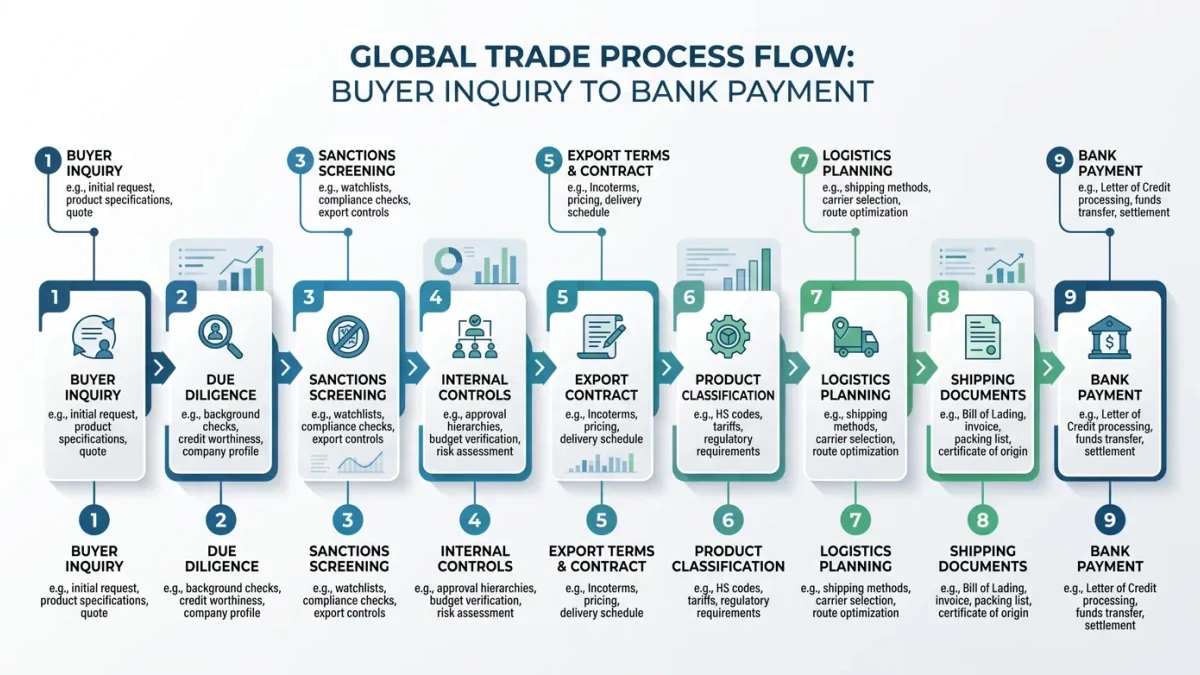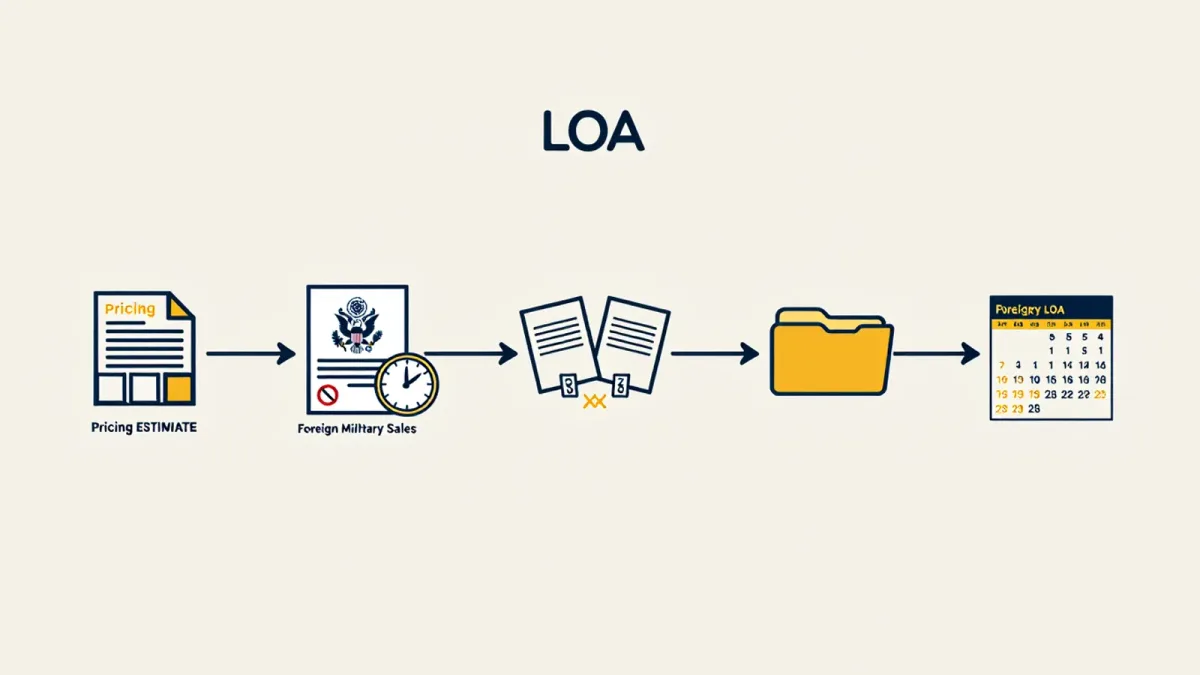
A signed weapons contract sets a delivery schedule, but the schedule only moves if the exporting government issues the licenses that lawfully allow the hardware to leave the country — and deals of $14 million or more in major defense equipment must also survive a 15-day congressional notification period, per DSCA practice. The license, not the contract, binds the calendar.
This is the least understood mechanism in the arms trade. Headlines treat contract signature as the finish line; practitioners treat it as the starting gun for a licensing process that runs in parallel with production and can outrun, or be outrun by, the factory itself. For air-defense and aviation programs — where every shipment bundles classified technical data, controlled software and government-to-government paperwork — the licensing tail is long enough to set the true pace of delivery. This explainer walks the mechanism end to end, from application to license conditions to the schedule slips they cause.
What does an export license actually authorize?
An export license is a written permission from the exporting state to move controlled items or data to a named foreign recipient, for stated end use, under stated conditions. It is not a formality attached to a sale; it is a separate legal act. The license application is assessed against criteria the exporting government defines — regional stability, human rights concerns, technology protection, end-use verification — and the resulting document can carry conditions the contract never mentioned: authorized consignees, prohibited retransfers, expiration dates, reporting duties.
Because the license binds the exporter rather than the buyer, its conditions flow straight into the delivery plan. A licensed quantity can be smaller than the contracted quantity, forcing partial shipments. A license with a short validity window can force deliveries into a narrower calendar than the factory would choose. And a license that arrives late simply holds the finished goods in the plant, finished but unlawful to move. None of this shows up in the contract's delivery schedule, which is why published schedules and observed deliveries diverge.
ITAR or EAR: which regime runs which clock?
United States exports divide between two regimes. The International Traffic in Arms Regulations, ITAR, administered by the State Department's Directorate of Defense Trade Controls, covers defense articles and technical data — missiles, fire-control radars, seeker software. The Export Administration Regulations, EAR, administered by the Commerce Department's Bureau of Industry and Security, covers dual-use items — some electronics, materials, and software with both civil and military applications. A single missile shipment can touch both: the round under ITAR, its commercial-grade test equipment under EAR.
| Feature | ITAR (State/DDTC) | EAR (Commerce/BIS) |
|---|---|---|
| Covers | Defense articles, services, technical data | Dual-use goods, software, technology |
| License type | Agreement approvals, DSP licenses | Export licenses, license exceptions |
| Review body | DDTC with DoD, interagency review | BIS with interagency referral where needed |
| Schedule impact | Agreements plus licenses per program stage | Per-shipment licenses or exceptions |
| Extra gate | Congressional notification for major items | Entity List and end-user screening |
The regime split matters for schedules because the two processes move at different speeds and fail in different ways. State Department reviews of defense trade agreements and licenses are reported annually to Congress with average processing times measured in weeks; BIS publishes its own licensing statistics, and the two data sets are not comparable as printed. Publicly available sources do not establish a single reliable average for the full licensing chain on a complex program, because the chain is assembled from multiple applications, each with its own clock.
How do allied export-control systems add their own calendars?
US-origin is only one flavor of problem. European-designed air-defense and aviation hardware moves under national and European Union licensing regimes — national export authorities issue the permits, and the EU common military list defines what counts as controlled, but each capital keeps its own procedure, its own review depth and its own processing times. A Franco-German missile system sold abroad may need authorizations in every state where major components were made, and each approval is a separate decision on a separate clock.
For delivery schedules this multiplies the failure surface. A buyer negotiating with a multinational supplier is, in practice, negotiating with several licensing authorities at once, and the slowest one sets the shipment date. The US system's congressional notification has a defined 15-day review floor for major defense equipment; most allied systems have no fixed floor at all, which makes their timelines harder to predict in either direction. Publicly available sources do not establish reliable cross-national comparisons of military licensing times, precisely because the reporting standards differ.
Where does a delivery schedule actually slip?
Six points in the chain produce most of the observed delay, and contractors who plan around licenses know them by heart.
- Application completeness. Applications returned for insufficient detail about the item, the end user or the technical parameters restart the clock at zero. Industry comments to successive State Department reviews describe this as the most common self-inflicted delay.
- Interagency review. Contentious cases circulate beyond the licensing agency — to the Defense Department, other agencies, and in some cases Congress — and each added reviewer adds calendar time that no published average captures.
- Congressional notification. Sales of major defense equipment at or above the $14 million threshold carry a 15-day review period under the Arms Export Control Act; larger or more sensitive packages can run longer, and holds within that period stop the process without any public deadline for release.
- Third-party consents. Hardware with foreign-origin components or prior licensed technology may require retransfer or re-export approval from allied governments, adding another sovereign's calendar to the schedule.
- License conditions. Limits on quantities, consignees or validity dates can force reapplication mid-program, effectively double-licensing a shipment that was contracted as one delivery.
- Post-delivery compliance. End-use certificates, delivery verifications and returns of unsold hardware are licensing paperwork too, and they gate final case closure and often final payments.
The pattern to internalize: schedule risk concentrates at sovereign decision points, not at factory stations. A production line can be resourced, staffed and ahead of plan while the shipment sits in licensing limbo — which is why a delay framed as industrial failure is frequently a governmental one.
How do contractors and buyers plan around the license clock?
Mature exporters overlap the processes. License applications for follow-on shipments go in while current production runs, so the licensing queue works in parallel with the factory rather than behind it. Program managers build license lead time into contractual delivery dates — meaning some of the margin a buyer thinks is production slack is actually regulatory slack. Buyers with experienced ministries of defense file their end-user and end-use documentation early, because buyer paperwork is a documented input to application completeness.
The structural answer is government-to-government sales, where the Foreign Military Sales case itself does much of the licensing work: once Congress is notified and the case implemented, individual commercial license applications shrink, since the US government moves its own materiel under statutory authority. That is one reason air-defense buyers have clustered around FMS channels for interceptors and radars — not sentiment, but schedule. Direct commercial sales retain their place where flexibility and specific configurations matter, but their delivery calendars carry the full license-application tail.
What should a reader infer from a licensing delay?
Very little without more data — and that is the honest finding. A slow license can signal bureaucracy at volume, a genuinely hard interagency argument, a congressional hold, or a buyer's incomplete end-user file; externally these look identical. What the mechanism guarantees is sequencing: no lawful shipment precedes its license, so every delivery schedule is a licensing forecast wearing industrial clothes. When GAO reviews of export-control processing have examined timelines, they have consistently found the same structure — application quality, interagency routing and case complexity drive outcomes more than any single published average does.
So read delivery news accordingly. A contract signed with fanfare and a license issued quietly are two different events on two different calendars, and the second one decides when the launcher leaves the plant. That is the whole trade.