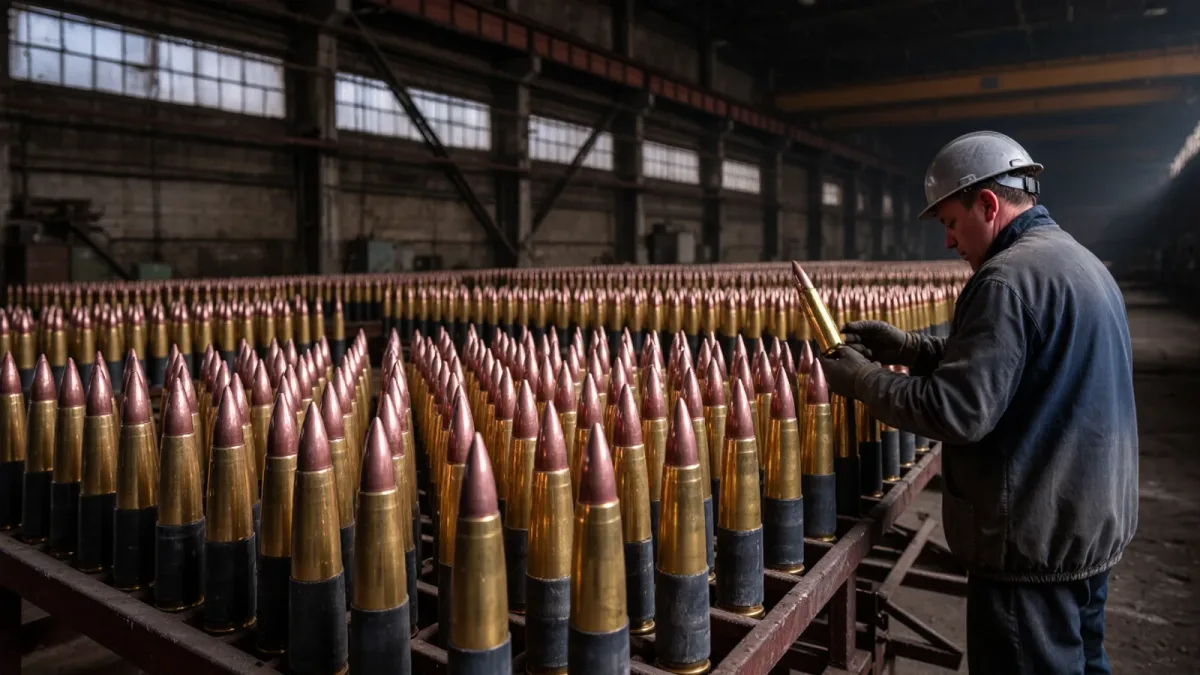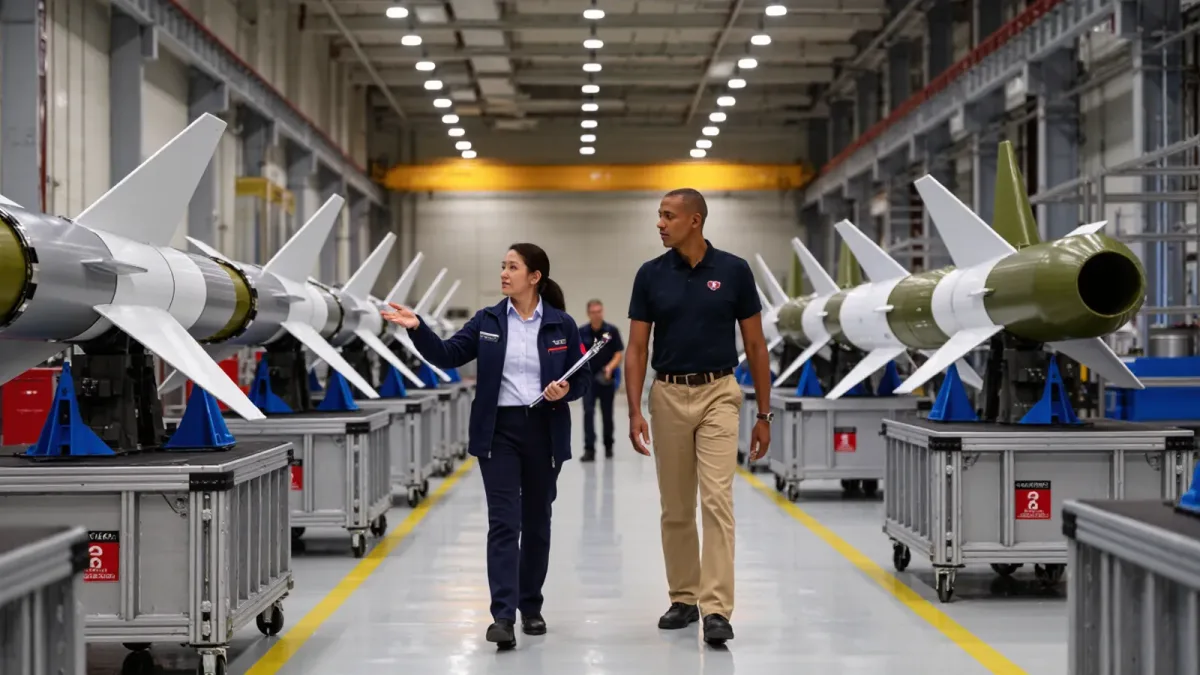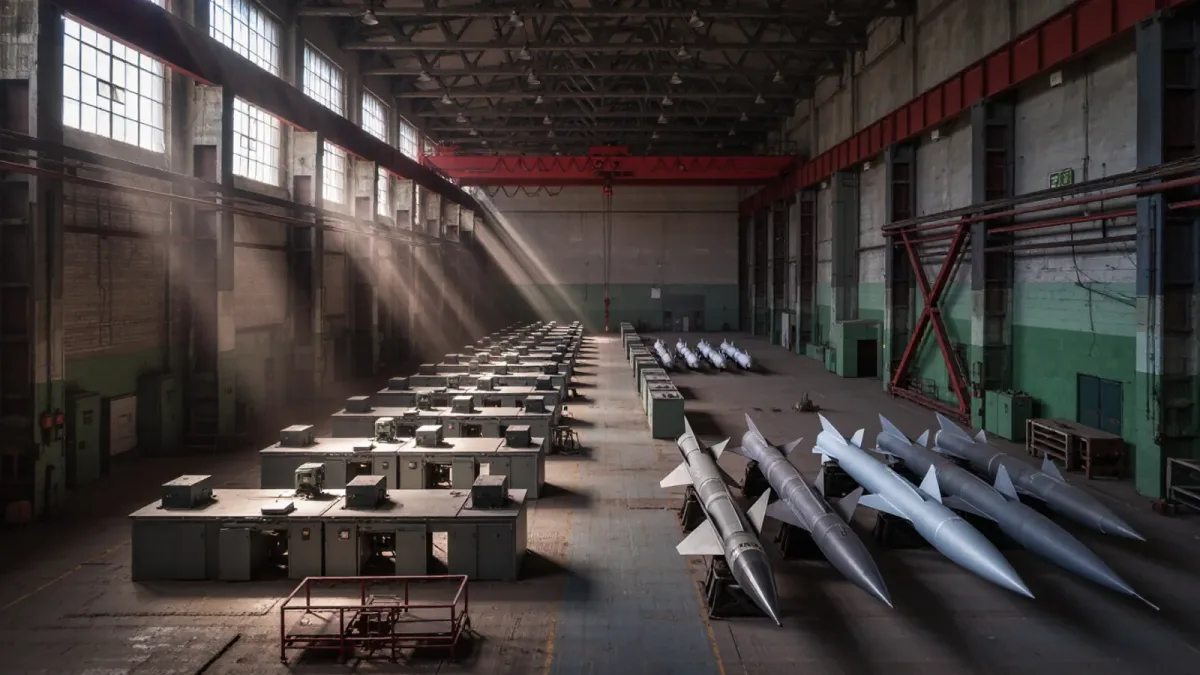
A paused defense production line costs money while it builds nothing, because the expenses that dominate a weapons program — factory space, tooling upkeep, engineering staff, certified suppliers — continue whether or not metal is moving, and a pause then adds reconstitution costs on top: rehiring and retraining the workers who left, requalifying suppliers who moved on, and restarting a process the learning curve has begun to forget. The best-documented illustration is the Air Force's own 2017 study of restarting F-22 production, which put a restarted production run of 194 additional aircraft at roughly $50 billion — several times the original jet's flyaway cost, per the report delivered to Congress.
That figure is the extreme case of a general mechanism. Missiles, munitions and air defense interceptors — the items this site covers most — sit on shorter, sharper versions of the same curve: small unit counts, specialist suppliers, and lot gaps of two or three years that erase hard-won efficiency. This piece walks through the cost anatomy of a production line, what precisely a pause destroys, and how program offices try to buy their way around the arithmetic.
What does a weapons production line actually cost to keep open?
Every unit price has two layers. The first is variable cost: materials, purchased components, direct labor hours — these scale with output and vanish when production stops. The second is fixed overhead: the plant itself, cranes, test chambers, tooling maintenance, program engineering, quality systems, security, and the supplier's own standing costs. Defense cost accounting calls these overhead pools, and contracts recover them through rates applied to direct work. When output falls, the pools do not shrink proportionally, so the rate charged to every remaining unit climbs.
On a missile line the mix is brutal. An interceptor program at a few hundred units a year carries guidance-section engineers, propulsion specialists and a chain of sole-source component houses, each with its own minimum viable workload. Government cost analysis of munitions programs has repeatedly shown unit costs driven as much by the overhead rate as by the bill of materials — which is why annual quantity is itself a unit-cost variable, not just a budget question.
What exactly does a pause destroy?
Three assets decay the moment work stops. The first is the learning curve. Decades of aerospace cost analysis — the tradition running from T. P. Wright's 1936 work on aircraft production onward — show unit labor falling by a predictable percentage with each doubling of cumulative output. A pause does not merely stop the curve's descent; workers and process engineers forget, tooling is repurposed, and the next lot starts partway back up the slope it had already paid to descend.
The second asset is people. Certified missile assemblers, welders with program-specific qualifications, first-line supervisors — a pause of even a year lets them take other jobs, and a fighter factory in a hiring market does not hold specialists on idle pay. Rehiring is the cheap part; retraining and re-certifying against program quality standards is where the schedule and cost go. The third asset is the supplier base. Small component houses — specific microcircuits, energetic materials, gyroscopes — cannot survive a program gap on hope; they redeploy staff, sell tooling or close, and restarting a sole-source supplier means new qualification, new documentation and often new tooling at the government's or the prime's expense.
What did the F-22 restart study actually find?
The Air Force's 2017 report to Congress examined restarting the F-22 line Lockheed had closed in 2012 and concluded that 194 new aircraft would cost roughly $50 billion — an average around a quarter-billion dollars per jet, far above the fleet's historical unit flyaway cost. The drivers it documented were precisely the assets described above: tooling that had been removed and would need rebuilding, a supplier base dismantled, and a workforce and process knowledge dispersed since shutdown. The study killed the restart idea on arithmetic alone.
Its lesson generalizes down to munitions. No missile program's pause produces a quarter-billion-dollar restart, but the ratio — restart cost per unit several times continuing production cost per unit — recurs at every scale. That ratio is why munitions program offices fight for multiyear orders and steady annual quantities with an intensity that looks political but is in fact the learning curve and overhead arithmetic speaking.
What happens when a program is terminated mid-stream, not just paused?
Termination adds a legal layer. The A-12 stealth attack aircraft case remains the canonical study: the Navy terminated the contract for default in 1991, and the resulting litigation over recovery of progress payments — a government claim that with interest exceeded $2 billion — ran for more than two decades through the federal courts before settling in 2014, with the contractor teams repaying amounts reported near $450 million each, per contemporaneous reporting on the settlement. The case established how expensive it is, legally, to stop a major program once started.
Even short of default, termination liability is real money: the government owes the contractor incurred costs, settlements for completed work, and often substantial fees on work in progress. This is the financial reason canceled programs still bleed budgets for years, and it feeds back into the pause question — a program office weighing a gap in orders knows that the cheaper-sounding option, stopping entirely, can trigger liabilities and restart costs that dwarf the cost of keeping a low-rate line warm.
How do buyers keep lines warm through gaps?
The standard tools are three. Economic order quantity contracting pools several years of funding into one order, holding the line open across budget cycles. Advance procurement — long-lead component buys funded in the gap year — keeps the supplier base moving even when final assembly output dips. And industrial base support programs pay explicit retention money for critical suppliers, an admission by the department that the market alone will not keep single-source capabilities alive. Each tool costs money; the argument in every budget review is that they cost less than the restart curve, and GAO reviews of munitions industrial base issues have generally supported that arithmetic.
The reader's practical rule: when a program's next lot shows a unit cost jump with no advertised upgrade, look for the gap. The explanation is usually not greed or inflation but a two-year hole in the order book that the learning curve, the overhead pools and the supplier base are collectively billing to the next buyer.