A public threat assessment establishes three things and only three: what an actor can do, what its behavior suggests it intends, and how likely analysts judge each — all graded on explicit confidence language. The rules for that language are themselves published. Intelligence Community Directive 203, issued by the Office of the Director of National Intelligence in 2007, sets the analytic standards every US intelligence product must meet, including the confidence scales that let a reader tell an assessed fact from an inference.
That published rulebook is the most underused tool in security reading. When the ODNI releases its Annual Threat Assessment — an unclassified edition has accompanied congressional testimony in recent years — the document is not a list of secrets. It is a structured argument with visible scaffolding, and the same scaffolding rules apply to allied products from the UK's assessments to NATO's strategic analysis.
What can an assessment establish about capability?
Capability claims are the firmest ground. Force counts, missile ranges, defense budgets, production rates and deployed systems are observable, and intelligence on them can be corroborated across imagery, signals and open sources. The Annual Threat Assessment's capability sections — China's military modernization, Russia's force status, North Korean missile development — rest on collection that has been accumulating for decades, and on facts partially visible in the open record: satellite photos of construction, state media, official announcements.
The published tradecraft still grades this ground. ICD 203's language distinguishes high confidence from moderate and low, and a high-confidence capability judgment in an assessment still does not mean the analyst has seen the object — it means multiple independent streams point the same way. A reader should carry the same discipline outward: a manufacturer's datasheet range is a claim by the manufacturer, a flight test is a demonstration under controlled conditions, and neither is an operational guarantee. The assessment tradition treats each differently, and so should any careful reader.
What can it establish about intent — and why is that harder?
Intent is inference, and the methods literature is unusually candid about it. The classic framework comes from Sherman Kent, the CIA analyst whose 1964 study Words of Estimative Probability standardized the language — "probable," "almost certainly" — so that policy readers would know what odds each phrase carried. Richards Heuer's Psychology of Intelligence Analysis, published by the CIA's Center for the Study of Intelligence in 1999, documented why intent judgments fail: analysts anchor on past behavior, mirror-image their own logic onto adversaries, and resist evidence that disconfirms a formed hypothesis.
The method built against those failures is the Analysis of Competing Hypotheses, developed by Heuer inside the agency: list the plausible explanations, test each against all the evidence, and keep the hypothesis that survives contradiction rather than the one that feels most consistent. Where an assessment says an actor "is likely to," the phrase encodes exactly this machinery — a tested judgment, not a guess. What no published method can do is read minds: intent assessments are behavior-based projections, and the history of strategic surprise is largely the history of actors changing behavior faster than assessments updated.
What does the confidence language actually mean?
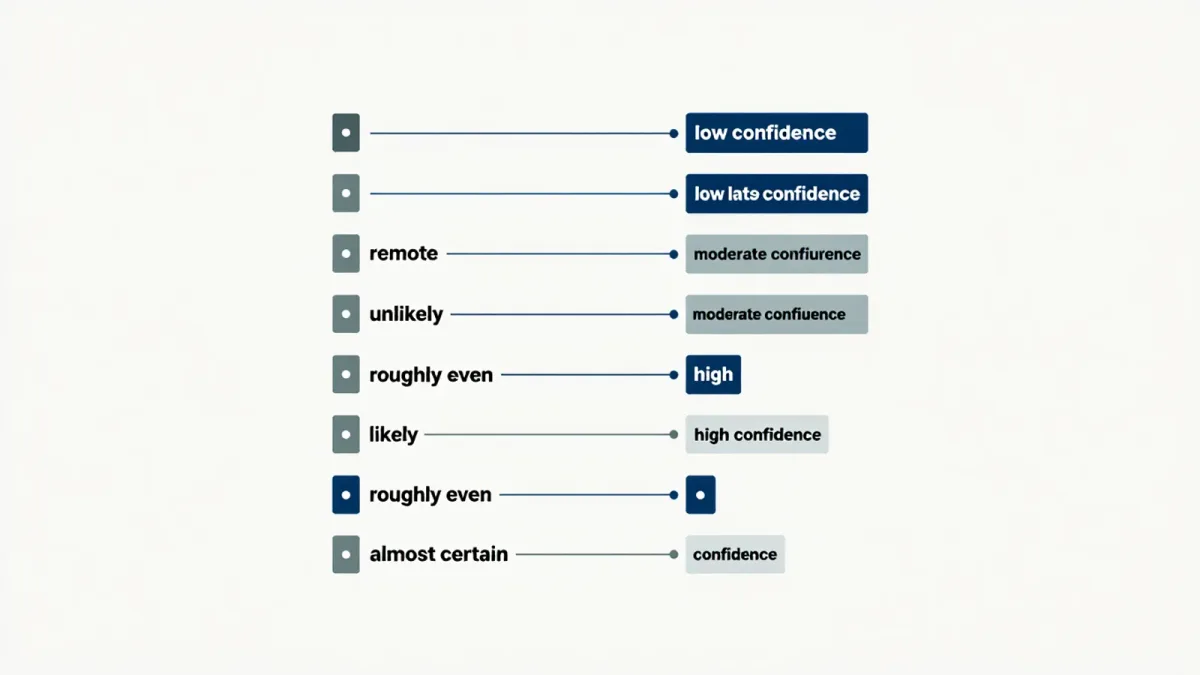
The IC's published scales pair probability and confidence, and conflating them is the most common reader error. Probability addresses the event — how likely. Confidence addresses the evidence — how solid the basis is. A high-probability, low-confidence judgment means analysts expect the outcome but are working from thin streams; a low-probability, high-confidence one means the judgment is well grounded but the outcome is genuinely unlikely. ICD 203 directs analysts to state both, and the unclassified assessments largely comply. The published guidance also warns against what it calls mechanistic scaling — attaching precise percentages to phrases — so the words are buckets, not odds.
Allied products carry parallel conventions: the UK's Professional Head of Intelligence Assessment framework and NATO's intelligence standards both mandate graded language, which makes the discipline portable across the English-language assessment world.
For the reader, one translation rule covers most cases: whenever an assessment's headline claim is carried by moderate confidence, the underlying evidence is contested or incomplete by the document's own admission, whatever the news cycle does with it.
What can a public assessment not establish?
Four limits are structural, not stylistic. Classification: the unclassified edition omits sources and methods, sometimes framing, so the public text understates what the government knows and cannot show why. Falsifiability: an assessment that says an attack is unlikely cannot be proven right by its absence — the non-event is invisible, which distorts hindsight evaluations of the analysts' record. Aggregation: a published assessment is the coordinated view, which means dissenting analytic lines have been negotiated into the text or footnoted; the public rarely sees the dispersion of views that shaped it. Provenance: most importantly, the reader cannot audit the evidence chain. The 2002 Iraq weapons of mass destruction estimate, later dismantled by the Iraq WMD Commission's 2005 report, remains the canonical case where coordination and source failure compounded — the commission's findings drove much of the ICD 203 reform language itself.
Publicly available sources do not establish how any current assessment's judgments were derived, and any writer who claims to know what the classified text says is asserting the unknowable.
How should a reader actually use one?
Three habits convert an assessment from a news item into an analytical tool. Read the confidence language out loud and flag every moderate or low. Separate capability statements, which are corrigible facts, from intent forecasts, which are tested projections with a documented failure history. And check the document's own hedging against how it is summarized downstream — most distortion happens between the assessment's prose and the headline that carries it. The published methods, from ICD 203 through Heuer's hypotheses, exist precisely so a non-cleared reader can grade the product's claims without seeing the evidence.
That is the whole trade. A threat assessment does not tell the future; it grades arguments about the future — and its own rulebook tells you how hard each grade was to earn.