A no-fly zone is a block of three-dimensional airspace in which designated aircraft are forbidden to fly, and it only works if the enforcing force can find, identify and, when needed, shoot down violators. That is the gap between the phrase and the operation. The term is easy to declare; enforcement demands a legal basis, a campaign against the ground-based air defenses underneath the zone, and enough combat aircraft to keep patrols running around the clock.
The mechanism is worth walking through, because the demand it places on an air force is larger than most readers expect. As the Lieber Institute at West Point explains in its analysis of no-fly zones and international law, such zones have usually been imposed without the consent of the state concerned, as with the operations over Iraq in the 1990s and NATO's 2011 operation over Libya, though some, like NATO's 1993 Operation Deny Flight over Bosnia, ran with consent. Either way, the enforcing force accepts the job of policing someone else's sky.
That policing job sits inside a wider discipline of managing who flies where, which is the same problem an airspace control order solves when jets, drones and missiles share one sky. The difference is that a no-fly zone adds an adversary who has not agreed to the schedule. For related coverage, see What an airspace control order actually coordinates when jets, drones and missiles share one sky.
What legal authority does a no-fly zone need?
There are three common routes. A United Nations Security Council resolution is the strongest, because it carries the authority of the Charter's enforcement provisions. A consensual arrangement with the state on whose territory the zone sits is the cleanest, since no sovereignty is being overridden. Imposing a zone without either one leaves the enforcing coalition arguing its own legal case, and the argument does not always hold.
The historical record shows how contested this can be. According to Wikipedia's overview of no-fly zones, the zones over Iraq after the 1991 Gulf War were not authorized by the United Nations, and then-Secretary-General Boutros Boutros-Ghali later called them illegal, while France's foreign minister said at the time that there was no basis in international law for that type of bombing. By contrast, the Security Council passed Resolution 816 in 1993, which authorized UN member states to take all necessary measures to ensure compliance with the ban on unauthorized flights over Bosnia.
The primary documents make the diplomatic work visible. In remarks recorded in the Public Papers of the Presidents from December 1992, President George H. W. Bush and Prime Minister John Major announced that they had agreed to cooperate on a UN resolution to enforce compliance with the no-fly zone over the former Yugoslavia, with Major describing the aim as preventing flights other than those specifically authorized. Note the sequence: the resolution came first, the enforcement came after. That ordering is not bureaucratic habit. It is what makes each subsequent engagement defensible under international humanitarian law.
Why can't patrols simply show up and start flying?
Because the ground fights back. Every modern state defends its airspace with surface-to-air missile batteries, radar sites, anti-aircraft artillery and command networks, and any of them can hit an enforcing aircraft. Before routine patrols can fly at useful altitudes, the enforcing force must suppress those defenses: jam the radars, destroy the launchers, and keep destroying the ones that move or reappear.
This is the step public debate usually skips. A no-fly zone over a state with a serious integrated air defense system is not a patrol mission with a legal annex. It is the opening phase of an air campaign, and the enforcing side has to be willing to strike sites inside the target country from day one. The Lieber Institute's analysis notes that enforcement, once a zone is lawfully established, may include lethal force subject to the rules of armed conflict, with rules of engagement typically adding verification and escalation-of-force procedures before firing. The zone's edges are lines on a map; the risk lives underneath them.
How much patrol tempo does enforcement actually demand?
Airspace does not stay closed while nobody watches. Enforcement means continuous combat air patrols, tankers to refuel them, surveillance aircraft to build the air picture, and rescue assets staged in case a pilot goes down. The Bosnia case shows what the scale looks like: per Wikipedia's account, as many as 400 NATO aircraft took part in the air campaign connected with Operation Deny Flight, and NATO's first ever combat engagement came when its aircraft shot down four of six Serb jets that had bombed targets inside the zone in 1994. We covered a connected angle in How NATO air policing missions keep guarding airspace nobody expects to attack.
Tempo also burns out the force. Aircraft need maintenance hours for every flight hour, crews need rest, and the patrol schedule never pauses for weather or politics. A coalition that cannot sustain the rotation either lets the zone leak or borrows against its own readiness elsewhere. That trade-off is rarely stated when the zone is first proposed, and it is the reason enforcement commitments outlast the headlines that produced them.
What does escalation mean for the enforcing state?
The enforcing aircraft and the defending state's air force end up in direct combat, which means the enforcing state is at war with that state whether or not it says so. NATO's Secretary-General made this explicit in 2022 when the question of a zone over Ukraine was debated. According to the Lieber Institute's account, Jens Stoltenberg stated that the only way to implement a no-fly zone is to send NATO fighter planes into Ukrainian airspace and impose it by shooting down Russian planes, an assessment NATO judged could end in a full-fledged war in Europe. The White House press secretary at the time called such a zone escalatory for the same reason.
Our analysis: the term hides the three costs
Reading the published record as a set, the pattern is consistent. A no-fly zone carries three costs at once: a legal cost, paid in the authority and legitimacy secured before the first patrol; a military cost, paid in the suppression campaign against air defenses; and a political cost, paid in the direct combat relationship the zone creates with the state being patrolled. The 1992 Bush-Major remarks show the legal cost being paid deliberately, in public, before enforcement. The Bosnia and Iraq records show the other two costs being paid for years.
That is the whole trade. Declaring a zone costs a press conference. Enforcing one costs an air campaign, a standing commitment, and a legal argument that not every government will win. Anyone proposing the phrase should be able to say who pays each of the three costs, and for how long.
What should a reader take away from the record?
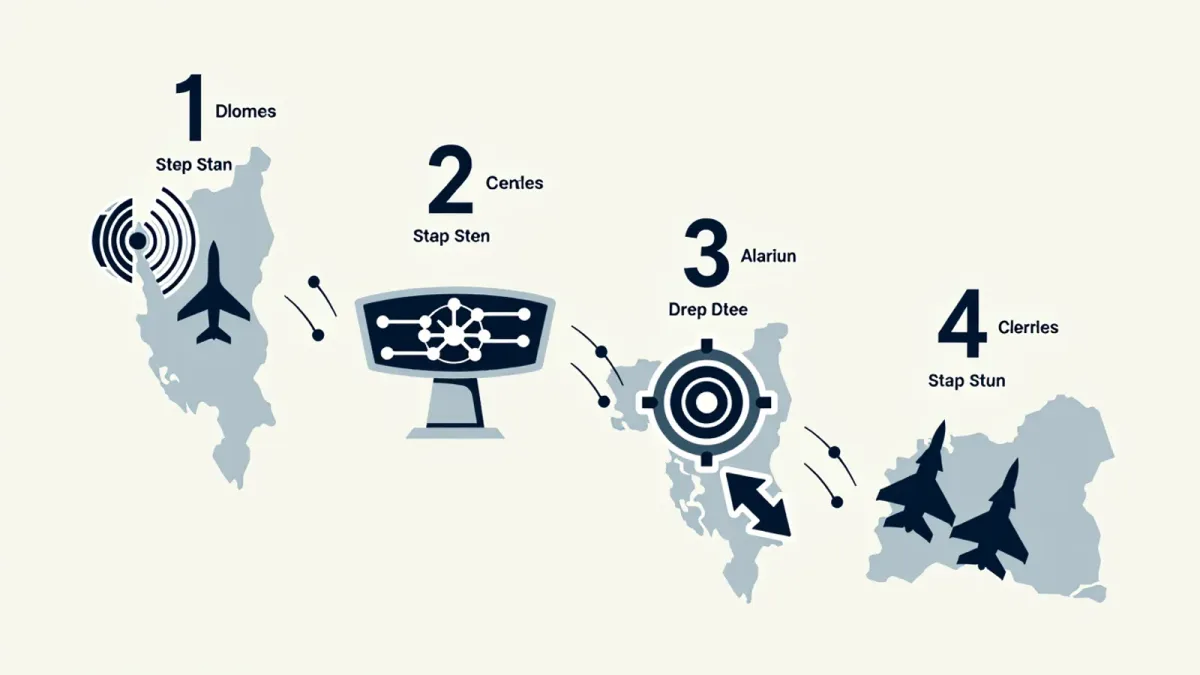
Take the sequence as the test of seriousness. First, the legal basis: a Security Council resolution, or consent, or a coalition prepared to defend its reasoning. Second, the suppression plan: which radars, which launchers, and what happens when they move. Third, the sustainment answer: how many squadrons, for how many months. A proposal that answers all three is an operation. One that answers none is a sentence.
For context on how states weigh commitments of this kind against their published plans, our coverage of what layered defenses are built to signal and of NATO air policing missions covers the consensual end of the same spectrum, where the aircraft being kept out have already agreed to stay out.