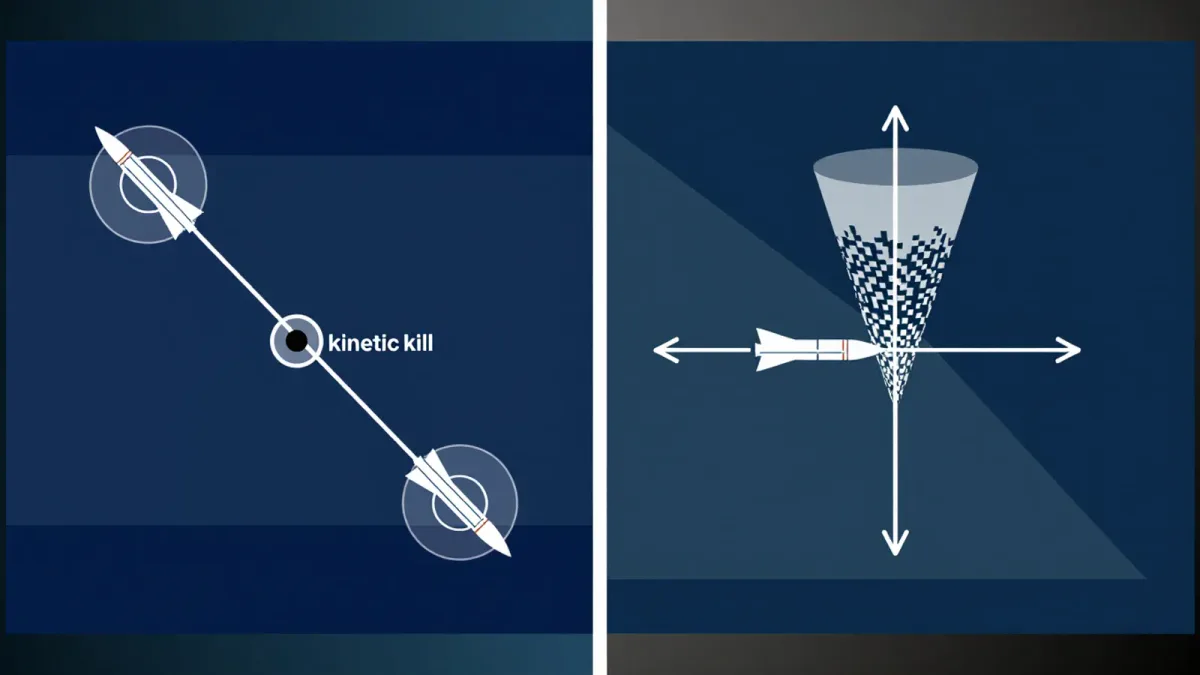
Every interceptor engagement ends one of two ways: a direct collision, a method called hit-to-kill that the Missile Defense Agency has demonstrated in claimed tests since 1999, or a proximity warhead detonated close enough that its fragment cone destroys the target. The agency describes hit-to-kill as hitting a bullet with a bullet, claims THAAD and SM-3 intercepts against intermediate-range targets by 2017, and fragmentation warheads still equip most short-range air defense missiles fielded worldwide.
The choice between the two is not a fashion. It is a trade among miss distance, target hardness, debris, and cost that shapes the interceptor's guidance, its seeker, and even the physics of the engagement. EDN News 12 explains both mechanisms from open sources; test statistics below are the agency's or manufacturer's claimed figures, not independently verified results.
What exactly is hit-to-kill?
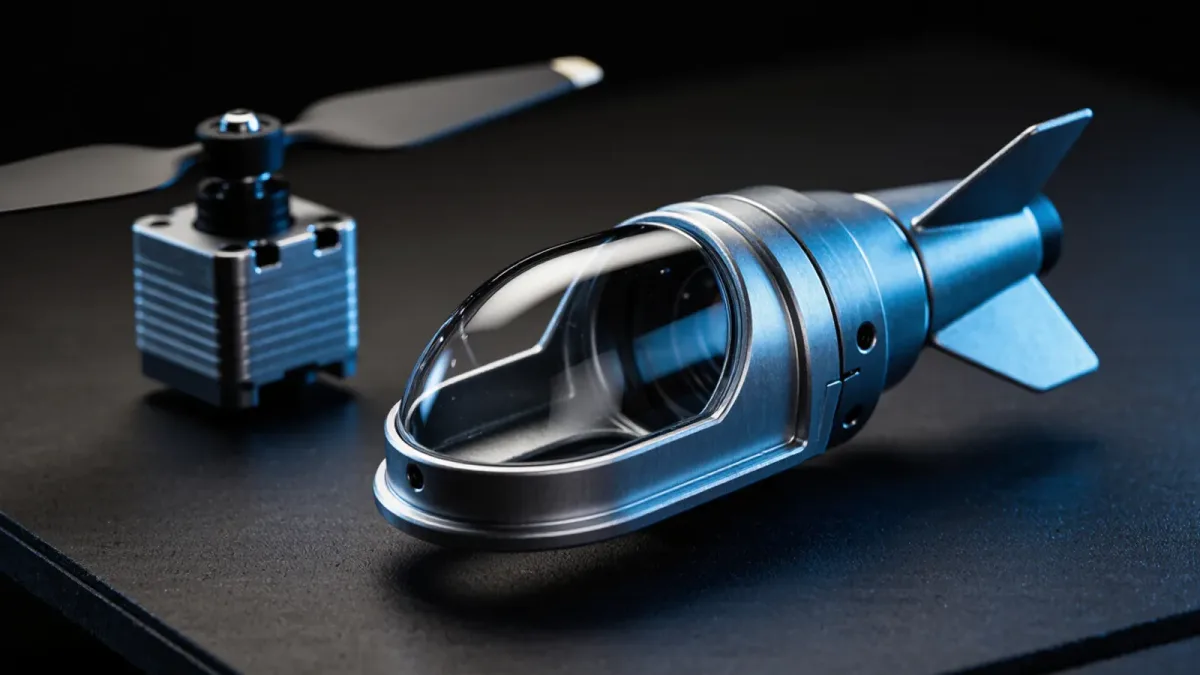
Hit-to-kill is a guidance method in which the interceptor carries no fragmentation warhead at all, only its own kinetic mass, and destroys the target by colliding with it at closing speeds that published test descriptions place in the range of several kilometers per second. The kill vehicle at the missile's tip uses its own seeker, small thrusters, and onboard processing to discriminate the target from decoys and steer onto a direct collision course in the final seconds, per Missile Defense Agency public descriptions of systems such as the SM-3 and THAAD.
The engineering price is precision: the miss distance must be near zero, measured in centimeters rather than meters, which demands a capable seeker, fast lateral control, and a fire-control track accurate enough to put the kill vehicle in the right corridor. The payoff is efficiency against the hardest targets, because a several-hundred-kilogram interceptor arriving at multi-kilometer-per-second closing speed deposits kinetic energy that no warhead can match, and against a nuclear reentry vehicle it removes the warhead's mass entirely rather than hoping fragments disable it.
That last point is the strategic one, and it is stated plainly in nonproliferation and defense literature: against a reentry vehicle built to survive a fragment impact, only the certain kill counts, because a damaged nuclear warhead is not a solved problem. The Missile Defense Agency's entire exoatmospheric architecture rests on that assumption, which is why the agency's public test claims center on direct hits and why critics scrutinize each test's realism, target representativeness included, so closely in open-source analysis.How does a proximity fuse actually work?
A proximity-fused interceptor closes on the target and detonates its fragmentation warhead at the computed optimum moment, when a radar fuse in the nose judges the target to be inside the lethal cone. The explosion sprays pre-formed tungsten or steel fragments outward, and the kill happens when one or more of those fragments strikes the target's airframe, seeker, control surfaces, or warhead. Systems such as the PAC-2, the SM-2, and most Russian-designed surface-to-air missiles described in open literature work on this principle.
The fuse timing problem is the subtle part. Detonate too early and the fragments arrive spread too thin to guarantee a hit; detonate too late and the fragments chase a target that is receding faster than they fly. The aim point also matters: published descriptions of continuous-rod warheads, which expand into a ring that slices aircraft structures, explain why anti-air warheads are designed against specific target geometries rather than as generic blasts. Against aircraft, this method is proven and forgiving of meter-scale guidance errors. Against a reentry vehicle or a hardened warhead, fragments may not suffice at all.
Why does the choice of kill method change the whole missile?
The kill method propagates backward through every design decision. Hit-to-kill demands an expensive seeker and guidance section in the interceptor, which is one reason per-unit costs of exoatmospheric interceptors run high in published DoD budget figures. Fragmentation warheads accept looser guidance in exchange for a warhead section, propellant, and fuse, which is why they remain the default where targets are aircraft and cruise missiles moving at manageable speeds within the atmosphere.
Miss size tolerances differ by orders of magnitude: a fragmentation design can achieve lethality with a miss of several meters, while a hit-to-kill vehicle needs centimeters. That tolerance gap is why the two families coexist rather than one replacing the other. Within the atmosphere, at endoatmospheric speeds, aerodynamic control surfaces suffice to guide a fragmentation missile to its cone of fragments. Outside the atmosphere, where there is no air to steer against and no room for error, only hit-to-kill works against a predictable ballistic target, per the Missile Defense Agency's own descriptions of why SM-3 and THAAD exist as separate tiers.
Why did hit-to-kill take decades to master?
The reason is guidance, and the history is documented in Missile Defense Agency test records. Keeping a collision course against a target closing at several kilometers per second requires the interceptor to sense the target, compute a predicted intercept point, and steer with thrusters in the last seconds, all inside an envelope where a human cannot react. Early American exoatmospheric programs of the 1980s and 1990s, including the Homing Overlay Experiment described in agency histories, proved the concept with deliberately oversized kill vehicles before miniaturization caught up.
The milestones are claimed test results, and each is attributed: the PAC-3 recorded its first hit-to-kill intercept in a March 1999 test, per Missile Defense Agency and Lockheed Martin statements; SM-3 scored its first exoatmospheric intercept in 2002; and in February 2008 an SM-3 launched from a U.S. Navy destroyer destroyed the failed USA-193 reconnaissance satellite, an event the Department of Defense documented publicly at the time. None of these figures is independently audited, but the underlying events are among the best-documented intercepts in the public record.
Miniaturization also explains the cost curve. A kill vehicle is a seeker, an inertial package, and a thruster set precision-built in small numbers, which is a major driver of the per-unit interceptor prices listed in Department of Defense budget documents. Proximity-fused missiles avoid that expense and keep their guidance burden in the launch platform's radar, which is the economic root of the two-family system the field settled on.
What happens when the interceptor misses?
The failure modes differ in instructive ways. A proximity-fused engagement that detonates near but not on the target may damage it, which in wartime produces the ambiguous outcome of a damaged missile that continues or an aircraft that limps home; assessments of damaged-but-not-destroyed outcomes are among the hardest claims to verify in public conflict reporting. A hit-to-kill engagement that misses is a clean miss, and the target continues untouched, which is why hit-to-kill doctrine emphasizes firing pairs.
Debris separates the two methods as well. A direct kinetic kill at high altitude vaporizes much of the interceptor and target, while fragmentation bursts at low altitude over populated areas rain fragments downward, a debris problem cities have documented after large interception raids. Neither method eliminates the threat's own mass falling from the sky; the fragmentation approach simply adds the interceptor's fragments to the tally.
Which method wins, and where?
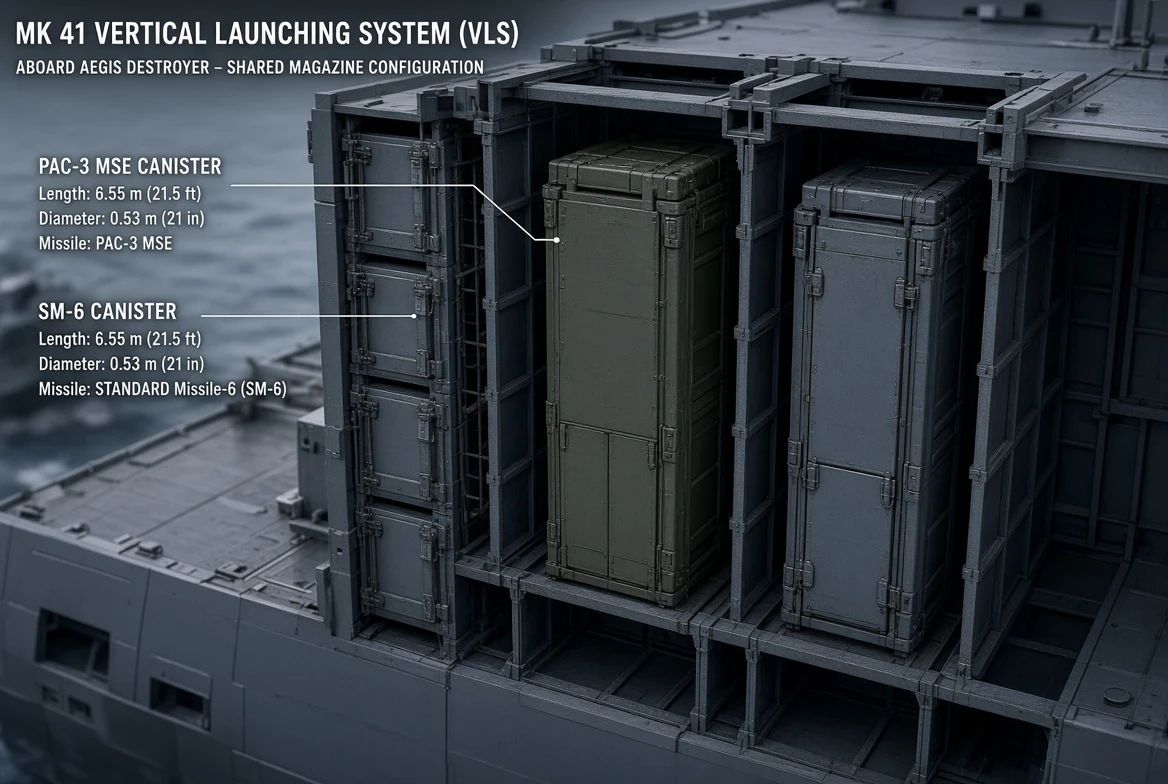
The honest answer is that each wins its own regime, and modern layered defenses deliberately carry both. Hit-to-kill owns the exoatmospheric and terminal-ballistic missions, where targets are fast, hardened, and intolerant of near misses. Proximity fusing owns the atmospheric short-range missions, where targets are numerous, softer, and cheaper, and where the interceptor's own cost must stay low enough for deep magazines. The PAC-3 family illustrates the split inside a single program: the older PAC-2 missile uses a fragmentation warhead, while the PAC-3 and its MSE variant are hit-to-kill designs packed densely on the same launcher, per Lockheed Martin's published materials.
The trend line visible in open procurement documents through the mid-2020s runs toward hit-to-kill for anything fast and valuable, and toward cheap, partly guided effects for the mass drone threat. The two kill methods are therefore not competitors so much as brackets around the threat spectrum. What the target is, how hard it is, and how much a miss costs decide which bracket closes around it.