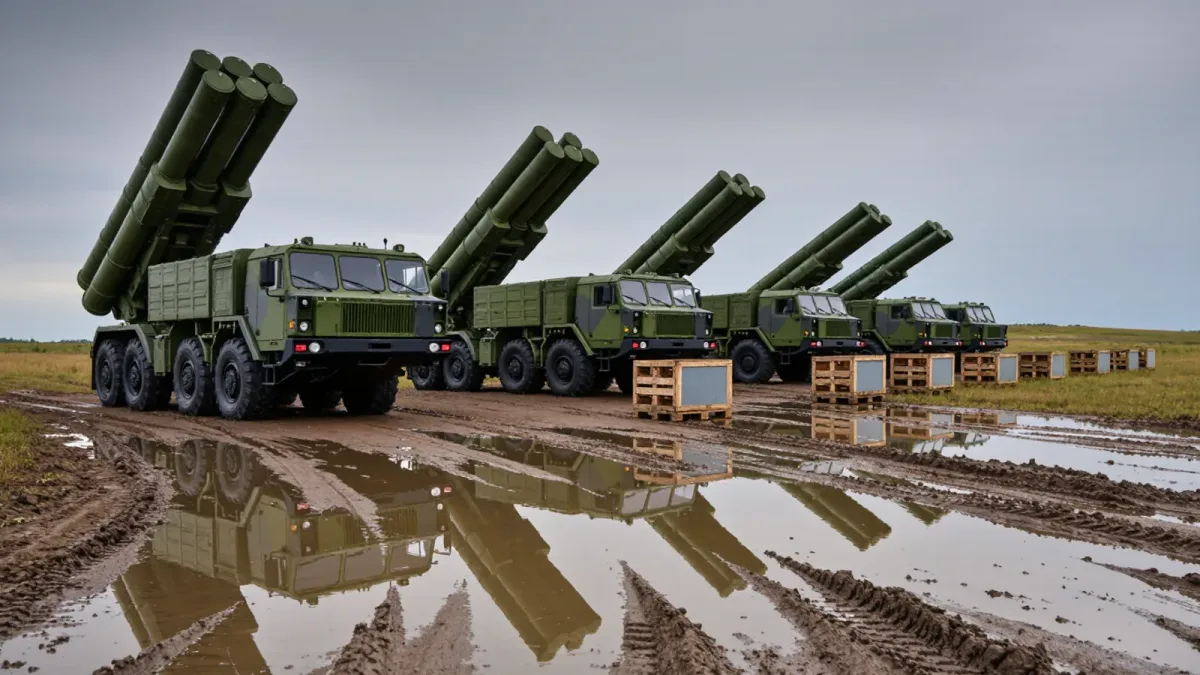
Magazine depth is the number of interceptors a defense can actually fire before its launchers run empty, and the arithmetic is unforgiving: a Patriot battery fields up to 16 missiles in the PAC-3 configuration on one launcher, four canisters of four, per Lockheed Martin's published materials, and a defense that fires two interceptors at every incoming threat halves that inventory with every salvo. When the last canister is gone, the battery's coverage does not degrade. It stops.
The term gets used loosely in public debate, so it is worth pinning down. Magazine depth is not how many missiles a country has bought in total; it is how many sit charged on launchers and in ready storage at the defended site at the moment the raid arrives. EDN News 12 works from open sources: budget documents, manufacturer claims, and named analyses. Wartime interception claims carry the standard caveat that information from conflict zones is contested and hard to verify.
What does magazine depth actually count?
Magazine depth counts usable rounds in position, not production lines or warehouses on another continent. A battery with a full combat load, a part-loaded drill stock, and nothing in local reserve has a shallower magazine than its total inventory suggests, because reload missiles may sit days of transport away from the launchers. Published U.S. Army structures make the constraint visible: an Army Patriot battery operates a set number of launchers, and each launcher holds a fixed number of canisters, so the whole site's depth is multiplication followed by subtraction.
The configuration choice changes the number materially. A PAC-3 configured launcher carries 16 hit-to-kill missiles where the same launcher in the older PAC-2 configuration carries 4 larger missiles, per manufacturer materials, a four-fold depth difference that exists because the smaller missile permits denser packing. Depth and single-shot lethality trade directly against each other, and every procurement of interceptors is a quiet vote on that trade.
How fast does a magazine empty under salvo attack?
Salvo tactics are built around the defender's arithmetic. If a defense engages each incoming missile with two interceptors, a tactic commonly assessed in open-source analysis of doctrine to raise single-pass kill probability, then a raid of 40 missiles asks the battery for 80 rounds, five full PAC-3 launchers. An attacker who launches 100, in a pattern resembling the massed strikes publicly reported during the Red Sea shipping campaign of 2023-2025, has asked a question about inventory that no amount of radar quality answers.
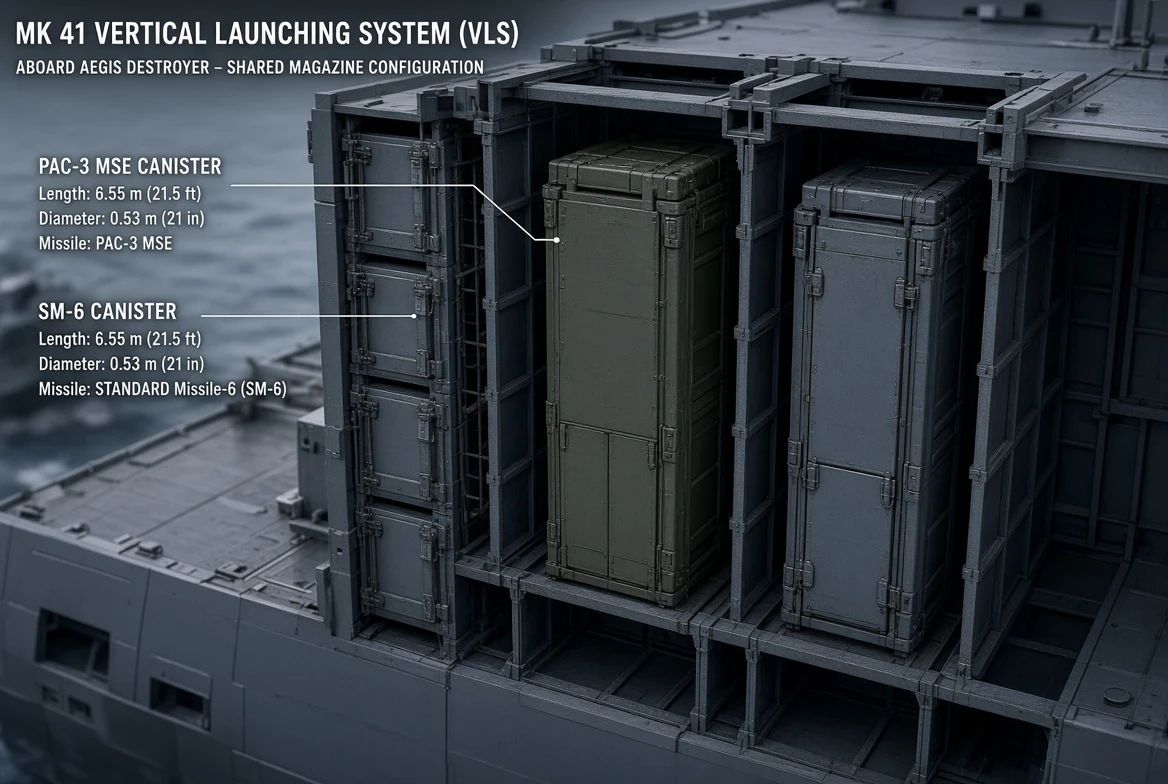
Timing compresses the problem further. Interceptors cannot be cross-loaded between launchers in minutes under fire, and a launcher emptied in the first two minutes of a raid is dead weight for the remainder. Published reporting on naval engagements in the Red Sea, including Reuters coverage of U.S. Navy statements, noted that destroyers expended large numbers of Standard Missiles over months of operations and had to return to port to reload, because no ship in the U.S. fleet could re-arm Standard Missiles at sea. A warship at sea has the purest form of the problem: the magazine is everything it has.
How long does a reload actually take?
Reload timelines are the hidden half of magazine depth, and they are measured in hours to months. Tactically, reloading a Patriot launcher is a mechanical evolution measured in tens of minutes with a crane vehicle and trained crew, assuming the canisters are on site. Operationally, moving canisters from depot to battery involves transport, security, and inventory steps measured in days. Industrially, building the replacement round is measured in years: PAC-3 MSE production has run at roughly several hundred missiles per year, with the U.S. Army and Lockheed Martin publicly stating targets around 650 per year in the mid-2020s, per company and Army statements. Demand signals from Ukraine and the Middle East after 2022 repeatedly exceeded those rates.
That three-clock structure, minutes, days, years, is why magazine depth is a strategic number rather than a tactical one. A defense can recover its tactical posture in an afternoon. It cannot recover its industrial posture inside the same war.
What does an interceptor cost, and how does that shape the fight?
Unit costs shape how deep any magazine can afford to be. U.S. Department of Defense budget justifications in the mid-2020s list PAC-3 MSE unit costs in the low millions of dollars per round, roughly $4 million per missile in recent procurement lines, and comparable figures for the Navy's Standard Missile family. The defender therefore pays millions per engagement against threats that can cost orders of magnitude less, an exchange the defender accepts only where what is being defended is worth more than the rounds.
The cost curve drives two visible responses in recent procurement, both documented in U.S. budget requests through 2025: buying deeper inventories of the expensive missiles, and accelerating cheaper complements such as guns, rockets, and lasers for the targets that do not justify a $4-million intercept. Both responses concede the same point. The interceptor is too good, and too scarce, to waste.
How does a defense manage a magazine it cannot refill?
Fire control doctrine builds conservation into the software. Weapons assignment systems can be directed to fire single shots instead of pairs against lower-value targets, to withhold fire where the predicted impact point is unimportant, and to hand engagements to a cheaper layer when one is available. Israeli reporting on Iron Dome operations during the October 2023 attacks, per statements by the Israel Defense Forces covered by Reuters and the BBC, emphasized exactly this filtering: rockets predicted to land in open ground were not engaged at all.
The strategic layer is allocation across theaters. A country with six batteries and five threats must choose which sites stay covered while launchers reload, and allies sharing stockpiles, as the U.S. and its partners have done publicly since 2022 with transfer programs, are spending magazine depth from a shared account. Open sources do not establish the specific reserve levels any nation maintains; that number is among the most guarded figures in any defense ministry. The structure of the problem, however, is public: radars find the raid, software assigns the shots, and the magazine decides how long the answer lasts.
That is the whole trade. An air defense system is measured in detection ranges and kill probabilities, but it fights in inventory. The side that counted missiles before the first launch already knows how the evening ends.