A depot backlog shrinks a fleet the way a frozen account shrinks a budget: the aircraft still exist on paper, but the jets stuck waiting for heavy maintenance stop being force structure the day they enter the queue. The scale was visible in 2017, when Navy officials publicly disclosed that fewer than half of the service's F/A-18C/D Hornets were mission capable, and pointed to aircraft waiting in the depot system as one of the leading causes — jets counted in inventory but unavailable to deploy.
This explainer relies on public documents, service statements, and GAO reporting only; EDN News 12 is an online publication, not a broadcaster, and nothing here is advice of any kind.
What is depot maintenance, and why does it bottleneck?
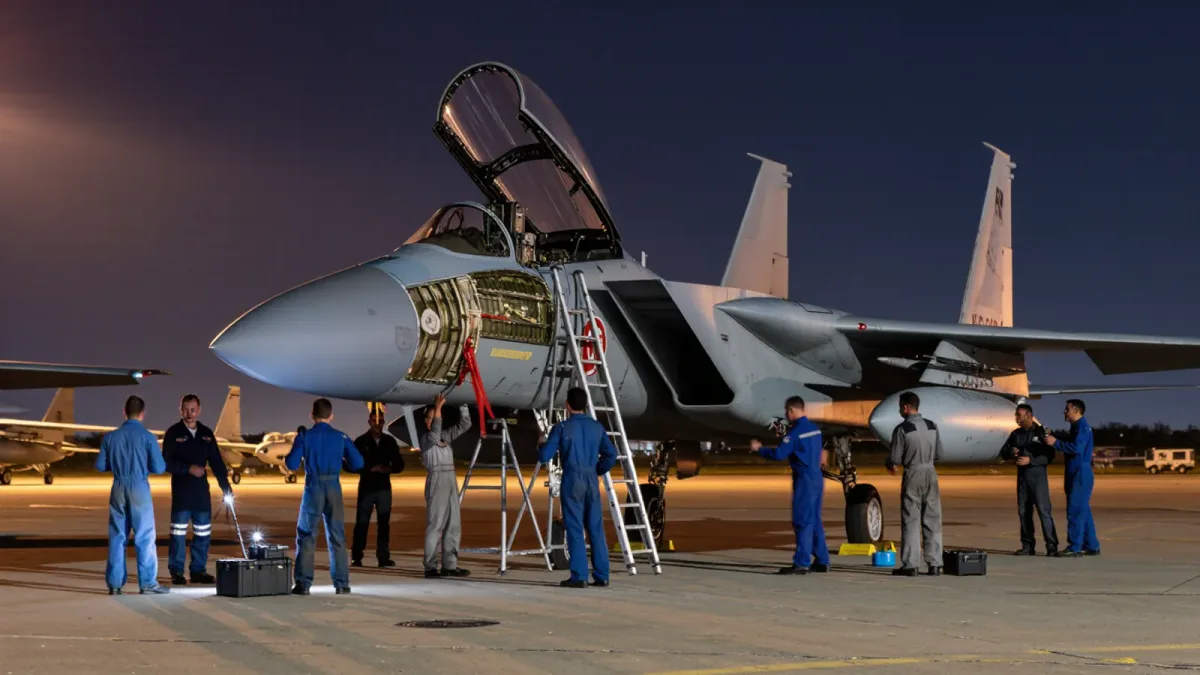
Depot maintenance is the heaviest tier of repair: work taken apart to structure, major component replacement, corrosion treatment, and upgrades that flight-line crews cannot perform. By US law, the services must keep roughly half of that workload in organic government depots, with the rest open to private industry. Capacity is therefore fixed years in advance by budget decisions, facility investment, and civilian hiring — none of which flex quickly when demand rises.
Demand, meanwhile, arrives on its own schedule. A fleet that flew hard for a decade presents itself for overhaul in a wave, and unplanned discoveries — corrosion deeper than estimated, structure cracks beyond the kit — stretch each job. GAO's 2020 review of Navy aviation depot work found that most sampled aircraft maintenance projects ran over their cost estimates and past their planned completion dates, which is the definition of a queue growing at both ends.
How does a backlog change the fleet's real size?
The inventory number and the flyable number diverge quietly. An aircraft pending depot transfer counts against a type's total strength until the paperwork moves it; an aircraft inside the depot counts nowhere useful. Availability statistics capture the result — a mission capable rate tells you what fraction can fly — but planning documents and headline fleet counts often do not, which is why a "1,000-aircraft fleet" with a 50 percent availability rate is a 500-aircraft force for every operational purpose.
Backlogs compound the gap in a second way: they age the fleet. Aircraft that wait years for induction keep flying past inspection intervals or sit parked and corrode, so the jets that eventually enter the depot arrive in worse condition and take longer to fix. The queue feeds itself. Public GAO reporting across the late 2010s repeatedly described this loop on tactical fleets — longer waits, worse induction condition, longer jobs.
Why do turnaround times slip?
Three mundane causes dominate the public record. First, workload peaks meet fixed capacity: when an entire generation of aircraft reaches its heavy-maintenance window at once, the depots and the contracted shops both saturate. Second, funding rhythm: continuing resolutions and late appropriations delay inductions, stall hiring, and push parts orders, so a depot's year starts before its money does. Third, material availability — a job cannot finish without its components, and obsolete or long-lead parts hold completed work hostage.
GAO's public assessments of depot performance have returned to these causes for years, and the office's recommendations cluster accordingly: better induction planning, more reliable parts forecasting, and steadier funding. The 2020 Navy-focused review added a measurement problem on top — the office found the Navy's own data on cost and schedule performance incomplete, which made management of the queue harder than the work itself.
How long can an aircraft wait before waiting does damage?
Waiting is not neutral, because corrosion and seal degradation do not pause at the hangar door. Aircraft parked pending induction still draw preservation work, security, and space, and a jet that waits three years often needs a bigger job than the one it queued for. The maintenance backlog therefore carries its own interest rate: deferred work grows more expensive the longer it sits, which is why availability recovered slowly even after readiness money arrived from 2017 onward.
There is a structural catch as well. The same aircraft that wait in the backlog often keep flying to cover the shortfall elsewhere in the fleet, accumulating hours and cycles that push them past their next inspection interval. The backlog converts readiness debt into airframe debt, and airframe debt converts back into longer, costlier depot visits — the loop closing on itself one more time.
What does a backlog cost beyond the hangar?
It reaches the flight line as cannibalization and risk. When repaired jets are scarce, units strip parts from their own parked airframes to keep the remainder flying, which quietly degrades the non-flying aircraft further and deepens the eventual depot bill. It reaches deployment schedules too: units train on fewer jets, qualification cycles stretch, and the surge capacity that a fleet's size implies exists mostly on spreadsheets.
The Navy's 2017 Hornet disclosure made the operational end explicit. Officials described extended waits for depot space as jets returned from years of carrier deployments, and the service's readiness recovery plan — funded by Congress from 2017 onward — put depot throughput and parts availability at its center, alongside restored flying hours. Recovery, when it came, was measured in turnaround times as much as in sorties.
A fleet's real size is the number that can fly on the day it is needed, and the depot queue decides that number first.
What fixes are actually on the table?
The public menu is short and unglamorous. Public-private partnerships let commercial maintenance capacity absorb workload peaks, and GAO has recommended expanding them with attention to cost comparability. Induction scheduling that smooths the arrival wave reduces the peak itself. Parts forecasting — buying long-lead components before induction rather than after discovery — attacks the most common cause of stalled jobs. None of it is fast, because capacity is built and staffed in years, not budget cycles.
Publicly available sources do not establish a single reliable figure for the combined deferred maintenance backlog across all services at any given date, and totals reported in different audits use different definitions. What the record supports is directional: queues lengthened through the 2010s, recovery funding from 2017 onward narrowed them in places, and turnaround time remains the number to watch in any depot conversation.