Airbus is selling its US Space Systems business to Cerberus Capital Management by the end of this year so it can concentrate on autonomous aviation, according to FlightGlobal. The deal has no disclosed price, and Cerberus says it expects to close by the end of December. On the surface it is a tidy portfolio move. The second opinion we would offer is that the more interesting part is not what Airbus is selling, but what it is betting on instead.
The divested unit is not a side project. It includes an 18,500 sq m (200,000 sq ft) small satellite factory in Merritt Island, Florida, where the Arrow 150 and Arrow 450 satellites are assembled for proliferated low Earth orbit constellations, plus contracted geospatial intelligence services using the WorldSAR imaging constellation. Cerberus calls the business a "mission-critical" satellite provider with more than 650 satellites produced and launched. That is a real, producing defence asset walking out the door.
Why is Airbus selling a working space business?
Airbus US Space & Defense says autonomous systems are more closely aligned with its core business. Chief executive Alex Veneziano argues the renewed focus will strengthen the company's competitive position with US defence customers. That is the official framing, and it is worth reading carefully: it is a strategy statement from the company making the sale, not an independent assessment. This connects to our earlier piece, What the space and missile defense symposium showed about allied integration.
A skeptic's reading is simpler. Two of Airbus's marquee US products are expected to leave service in the coming years, per FlightGlobal. The US Army plans to retire its UH-72A trainers in favor of a contractor-owned fleet of Robinson R66 light-singles, and the MH-65 Dolphin search and rescue helicopter is also expected to exit. The UH-72A/B will survive with the Army National Guard on domestic missions such as disaster response. Airbus's US defence business, in other words, is losing its anchor contracts. The space unit may be the cleanest asset to monetize while the company chases a replacement franchise.
What is the bet, exactly?
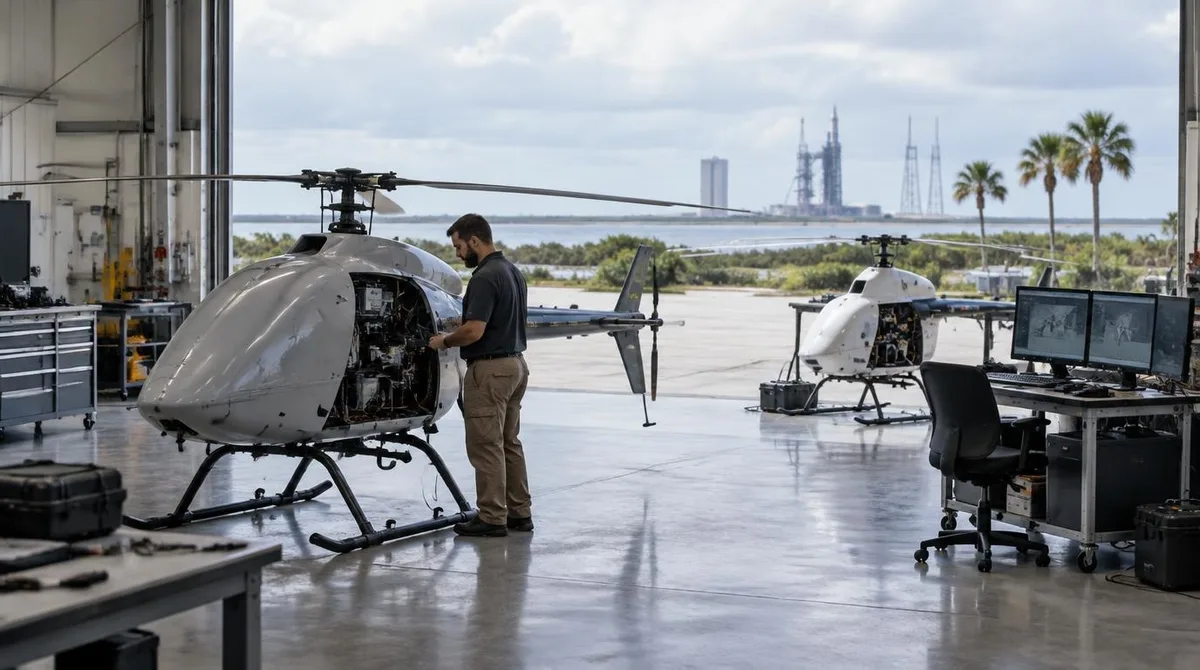
The replacement franchise is the MQ-72C, a heavily modified H145-based UH-72 Lakota built for the US Marine Corps' Aerial Logistics Connector programme. That programme aims to field an autonomous vertical take-off and landing aircraft for ship-to-shore resupply and support of troops on isolated island outposts. Shield AI supplies autonomous flight software, L3Harris contributes avionics hardware, and Parry Labs handles systems integration. Airbus US has logged multiple test flights of the prototype MQ-72 cargo helicopter, with more planned under the programme.
FlightGlobal reports the effort is seen as critical to the long-term health of Airbus's US defence business. That is doing a lot of work. A finalist position on a single Marine Corps programme is not a backlog, and the article does not establish that the Aerial Logistics Connector will reach production at scale. Readers should treat the autonomous pivot as a bet still waiting for its payoff, not a secured future.
Why does the buyer matter here?
Cerberus is not a disinterested financial buyer. The firm owns M1 Support Services, which won the US Army's Flight School Next contract to replace the government-owned UH-72 trainer fleet and its rotary-wing training curriculum. The same transaction that removes Airbus's Army trainer business is enriching the firm now buying Airbus's satellite factory. That may be coincidence, but it is the kind of coincidence a procurement watcher should note rather than wave away.
Cerberus co-head of the supply chain portfolio Craig Brooks says space is essential to US and allied national security and that the firm looks forward to expanding the unit's capabilities. A private equity owner saying it will expand a defence satellite business is a claim about intent, not a commitment with numbers behind it. The undisclosed price makes it impossible to judge what Cerberus thinks it is getting at what discount.
What should readers watch next?
Three things. First, whether the Aerial Logistics Connector competition converts the MQ-72C finalist position into a production award, since that is the entire thesis of the pivot. Second, the closing of the Cerberus acquisition by the end of December, and any later disclosure of terms. Third, the name: a source within Airbus tells FlightGlobal that Airbus US Space & Defense will not change its name immediately after the divestment, though that could change. A company called "Space & Defense" that no longer sells space systems is a small but honest signal of how recent this rethink is.
The evidence supports a narrow conclusion. Airbus is divesting a productive satellite business at an undisclosed price to fund a focus on autonomous aviation, where its flagship programme is a finalist position on one Marine Corps effort and its legacy US helicopter products are retiring. The strategy may well succeed. What the available reporting establishes is the bet, not the odds. Readers following this should also see Attack: A 20-year military aviation record helps one drone operator, but the claims remain his own.