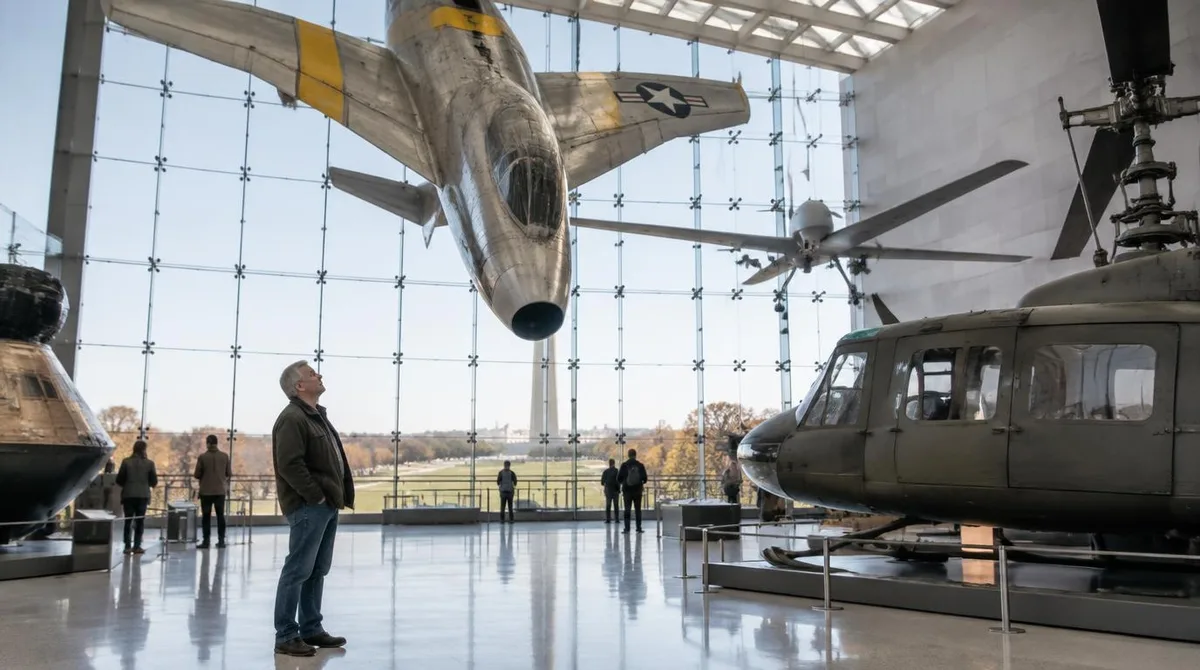
The Smithsonian National Air and Space Museum opens its Modern Military Aviation exhibit to the public on Nov. 11, Veterans Day. It covers U.S. military aviation from the end of World War II through the post-9/11 era, and it does that with three aircraft: an F-86 Sabre, a Bell UH-1H Huey, and an MQ-1L Predator. According to WTOP News, the gallery sits on the museum's top floor and spans the early Cold War to the drones used in the wars in Iraq and Afghanistan.
For anyone new to the subject, the exhibit is a compact course in how military aviation changed after 1945. The aircraft on display are not random picks. Each one marks a shift in how American air power fought: combat over Korea, rotary-wing warfare in Vietnam, and the armed drone era that followed. According to WTOP News, curator Michael Hankins of the museum's Aeronautics Department frames it as both the broad Cold War, with the invention of nuclear weapons, and the specific conflicts: Korea, Vietnam, Iraq, and Afghanistan.
This publication covers air defense and military aviation as an online outlet, not a broadcaster, and pieces like this one are where the hardware story starts. If you want the wider context of how air power fits into national security planning, our airdefense coverage follows the systems these galleries only hint at. For related coverage, see Balikatan 2026 closed with 17,000 troops rehearsing integrated air and missile defense across the Philippines. For related coverage, see Balikatan 2026 closed with 17,000 troops rehearsing integrated air and missile defense across the Philippines.
Why does the F-86 Sabre hang upside down at the entrance?
The F-86 Sabre is a Korean War fighter jet, and the museum suspends it inverted at the gallery entrance. According to WTOP News, Hankins calls it a technological marvel for its time and highly effective against MiG fighters. That effectiveness is the point of the Korean War chapter, and the aircraft that anchors it now greets visitors at the door.
The upside-down display is a staging choice, not a historical one. It puts a swept-wing jet at eye level and overhead in a tight gallery, which is how the museum signals that this aircraft opened an era.
What does the Huey say about the Vietnam War?
The Bell UH-1H "Huey" is one of the most recognizable aircraft of the Vietnam War, per the museum's own framing reported by WTOP News. In plain terms, the Huey turned helicopters from support machines into the core of how the Army fought: lifting troops, evacuating casualties, and moving crews across a battlefield with few roads. The exhibit uses the helicopter to carry that Vietnam chapter, the way the Sabre carries Korea.
Why is the Predator at the rear of the gallery so important?
The General Atomics MQ-1L Predator hanging at the rear of the gallery played a key role in the evolution of modern drone warfare. According to WTOP News, Hankins said this particular airframe "was the first one to ever fire precision weapons in combat." That single fact marks the hinge in the story: an unmanned aircraft went from a sensor to a shooter, and the drone program changed with it. "This was an important part of the history of the drone program," Hankins said, per the same report.
For readers who want more on that arc, our earlier piece on a 20-year military aviation record and one drone operator's claims looks at the human side of the same history. This connects to our earlier piece, Attack: A 20-year military aviation record helps one drone operator, but the claims remain his own. This connects to our earlier piece, Attack: A 20-year military aviation record helps one drone operator, but the claims remain his own.
What else is in the exhibit besides the three aircraft?
A wall of missiles, rockets, and machine guns traces how aircraft weapons evolved. The artifacts include unguided rockets, heat-seeking missiles, radar-guided missiles, and the AIR-2 Genie, a nuclear air-to-air rocket. According to WTOP News, Hankins said the museum is "really trying to speak to how specific all these weapon systems are and how they adapt to various mission types."
Two other items stand out. One is the gun from the A-10 Warthog: a 30 mm cannon more than 7 feet long with seven rotating barrels, which Hankins said fires depleted uranium bullets for armor-piercing against tanks. The other is the cockpit and forward fuselage of an F/A-18 Hornet that flew combat missions in Iraq and Afghanistan in the 2000s.
Why is the touchable F/A-18 fuselage a big deal?
Visitors are allowed to touch the Hornet fuselage, which the museum describes as a rarity. "We almost never let people touch our artifacts," Hankins said, per WTOP News, "but in this case, we wanted to let people have that direct connection in this way, and I think it's really powerful." The logic is straightforward: an aircraft that flew real combat missions two decades ago can carry a physical link to that history in a way a placard cannot.
Smaller artifacts carry a different kind of weight. The exhibit includes bracelets bearing the names of prisoners of war and the dates they were captured during the Vietnam War. The bracelets were widely worn to raise awareness and support for American POWs. "It was a way to keep their memory going and keep their advocacy for them going throughout the war," Hankins said, per the same report.
What should a first-time visitor actually do in the gallery?
Walk it in order. The entrance Sabre sets the jet-age start, the Huey carries the middle decades, and the rear Predator closes the arc in the post-9/11 era. Then slow down at the missile wall, where the AIR-2 Genie alone is worth a long look: a nuclear air-to-air rocket is a hard idea to picture until you stand next to one. Hankins told WTOP News he hopes people "take some time to wander through here and think about how this technology has really shaped the history of this country in the last 80 years or so."
That is the exhibit's real claim. It is not a trophy hall. It is a timeline you can walk in an afternoon, with the hardware doing the arguing. The Modern Military Aviation exhibit opens to the public Nov. 11.