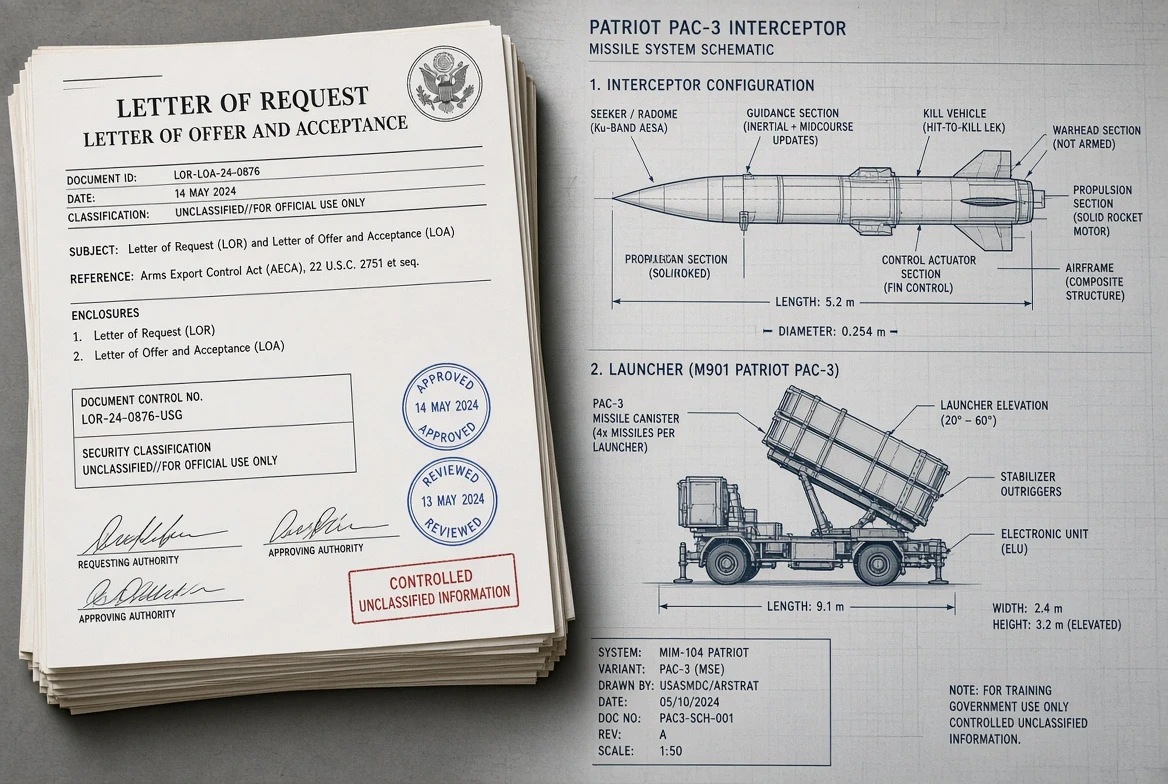
The Netherlands awarded Raytheon, the RTX subsidiary, a $627 million contract for Patriot air and missile defense equipment on April 8, 2026, per RTX's own announcement — a direct commercial sales deal covering Patriot radars, launchers, and command-and-control systems intended to modernize Dutch ground-based air defense.
The manufacturer is the attributed source for the award's value and scope; no independent contract filing has been published, so the figures below are the company's stated numbers. This publication is an online outlet, not a broadcaster, and we flag that up front because procurement coverage lives or dies on sourcing discipline.
What is the Netherlands actually buying?
Per RTX, the award funds Patriot system equipment — radars, launchers, and command-and-control — rather than a complete battery set alone. That composition reads as recapitalization: the pieces of a Patriot fire unit that age hardest in high-tempo use are the radar's electronics and the launcher hydraulics, and the Netherlands has run its batteries hard, contributing them to NATO's integrated air defense and, per Janes, donating one complete Patriot system to Ukraine in 2024.
That donation is the connective tissue here. Per Janes' reporting, the April order replenishes the system given to Kyiv, which means the Dutch are simultaneously financing one of Europe's most forward air defense contributions and refilling their own launchers — a two-magazine problem paid twice.
How does this fit the Dutch procurement pattern?
The April award is not an isolated purchase. The Netherlands ordered Patriot components including a radar unit and launchers in a $529 million contract announced in January 2025, and in March 2026 the Dutch government announced plans for a roughly $1.1 billion rush order for an additional Patriot system, per Defense News' March 24 report. Taken together, the sequence shows a mid-sized European state rebuilding launcher depth by successive tranches rather than one program-of-record decision.
Direct commercial sales also matter mechanically: unlike Foreign Military Sales, a DCS contract is negotiated directly with the manufacturer, which is faster to sign but sits outside the US government's case-managed delivery pipeline. What that means for actual delivery dates is not stated in the announcement — publicly available sources do not establish a delivery schedule for this award.
Why one mid-sized order matters to the wider picture
The Patriot production base is the binding constraint across all of these European orders, and every national buy — Dutch, German, Spanish — competes for the same line slots. A $627 million equipment award therefore says as much about queue position as about Dutch capability: the order reserves factory output years ahead. Manufacturer-claimed figures on capacity are exactly that, claims by the manufacturer, and no independent test or filing confirms current line throughput.
Per RTX, the contract supports modernization of Dutch air defense in the same year the Netherlands takes over NATO's PATRIOT-related coordination duties in multiple frameworks. The honest summary: a replenishment buy, announced by the seller, at a value that confirms Europe's interceptor appetite is still outrunning supply. That is the whole trade.