An integrated air defense system is a network that turns separate radars, command posts and missile batteries from different military services into one sensor-and-shooter web. Integration is not a single purchase. It is three architecture decisions: how sensors are layered, who is allowed to shoot at which track, and whether every unit can share the same picture.
Most countries own the parts already. An air force runs surveillance radars, an army fields short-range batteries, a navy brings ship-based interceptors, and none of them naturally talks to the others. The hard part is the wiring between them, both the physical data links and the human rules about who fires. This explainer walks through those choices in the order a defense ministry usually meets them.
Why does buying batteries come after designing the network?
Because the network decides what the batteries are worth. A battery that only hears its own radar defends the ground its radar can see. The same battery, fed tracks from a distant surveillance radar, can engage a target that has not yet crossed into its own sensor coverage. Planners therefore start with the question of what the network must see and share, then choose sensors and shooters to fill the gaps.
This is also why procurement orders look odd from the outside. When a country buys radars, launchers and command systems in one package, as the Netherlands did in a single modernization order, the point is not the hardware count. The point is that the new pieces are designed to feed one picture. Our Netherlands Patriot modernization order shows that pattern in a real contract. We covered a connected angle in The Netherlands put $627 million into new Patriot radars, launchers and command systems in a single April order.
There is a procurement trap here, and it is a familiar one. Batteries bought from different vendors in different years often arrive with proprietary data formats. Getting them to exchange tracks later can cost more than the original hardware. Ministries that specify open, standard interfaces up front avoid a decade of expensive translation work.
What does sensor layering actually mean?
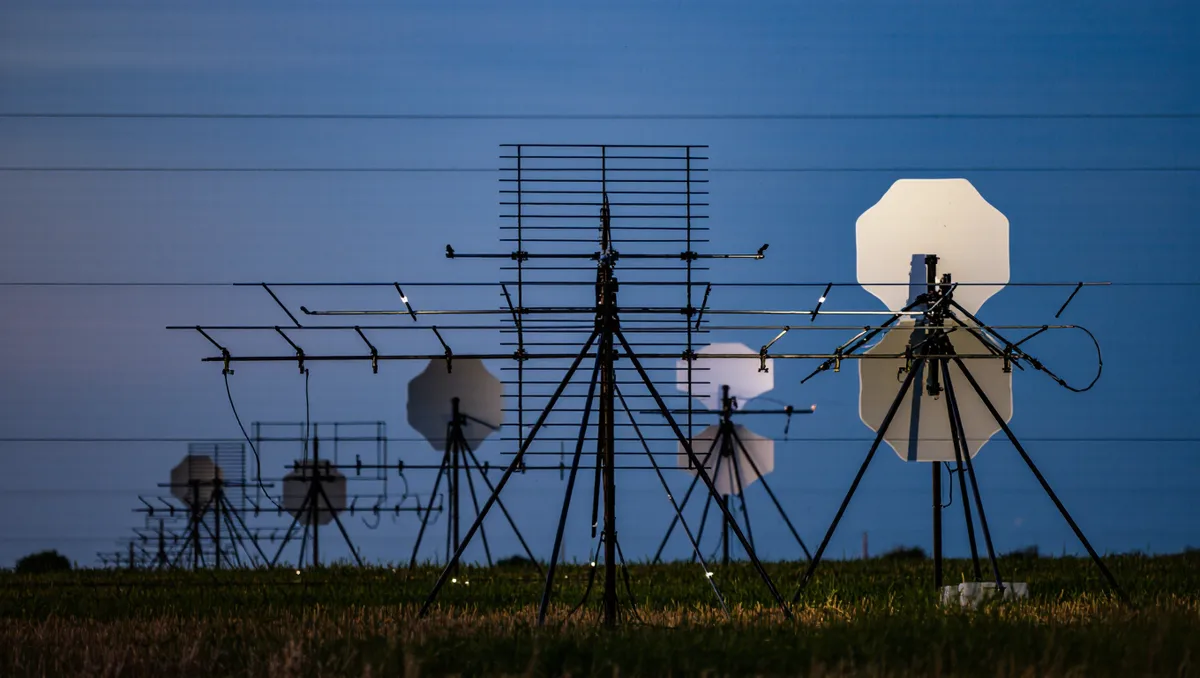
Layering means arranging sensors so that no single gap blinds the network. A long-range surveillance radar sees far but poorly at low altitude, because the curvature of the earth hides low-flying aircraft beyond the horizon. Ground-based radars also struggle against terrain masking, where a hill blocks the line of sight. So a national design typically stacks several kinds of eyes.
- Long-range surveillance radars for early warning and initial tracks.
- Gap-filler radars in terrain-shadowed regions and along likely approach corridors.
- Airborne sensors, either dedicated surveillance aircraft or fighters whose radars report into the network.
- Ship-based radars, which move the coverage with the fleet and can watch seaward approaches.
- Each battery's own fire-control radar, which is precise but narrow, and only switches on when a track is handed over.
The layering rule is simple: every sensor covers another sensor's weakness. The surveillance radar hands a coarse track to the fire-control radar, which refines it into a firing solution. If the big radar goes down or is jammed, the network degrades to a smaller picture instead of going dark. That is the whole trade: more sensors cost money, but they buy resilience rather than range.
How does shooter assignment work without chaos?
Assignment is the rule set that decides which weapon engages which target. Without it, two batteries waste missiles on the same aircraft, or worse, no battery fires because everyone assumes someone else will. A national system assigns each track to a shooter automatically or through a human in the loop, depending on the threat and the rules of engagement.
The assignment logic weighs several things. Geography matters first: which shooter has the geometry to make the intercept. Magazine depth matters next: a battery with few interceptors left should not be the first choice for a low-value target. Weapon-pairing matters too, since a high-altitude threat needs a different interceptor than a cruise missile skimming the treetops. The system also keeps engagement corridors clear, so a friendly fighter is never inside a battery's firing envelope when it launches.
Before any of this can happen, the network must decide the track is hostile. That decision runs through identification friend-or-foe, which is the gate every air defense engagement passes before a missile flies. Our IFF explainer covers why that gate exists and how it fails. For related coverage, see Identification friend-or-foe is the gate every air defense engagement passes before a missile flies.
Why do data link standards decide everything?
A common picture is only as good as the links that carry it. If army and air force units use incompatible formats, each service builds its own picture, and the two pictures disagree at the worst moment. The architecture choice is to adopt one standard message set, with defined fields for track position, speed, classification and confidence, and to require every new purchase to speak it.
Standard links do three jobs at once. They carry sensor tracks to the command post, they carry the common picture back out to every shooter, and they carry engagement orders and status reports. Latency matters as much as bandwidth, because a track that arrives seconds late against a fast jet is a historical document, not a targeting input.
Our analysis is that the link standard, not any single radar or missile, is the true backbone of a national system. Countries that treat it as an afterthought end up paying integrators to bolt networks together that were never designed to meet. Countries that specify it early can mix vendors freely, because any compliant sensor can feed any compliant shooter.
What does this mean for small countries with small budgets?
It means the architecture can be bought in the right order even when the hardware cannot. A small air defense force can start with two or three surveillance radars, one command post and a handful of batteries, all built to one link standard. Each later purchase then plugs in instead of starting over. The alternative, buying impressive batteries that cannot share data, produces isolated islands of capability that an adversary defeats one at a time.
Allied exercises show the same logic scaled up. When thousands of troops rehearse joint air and missile defense across an allied theater, they are practicing exactly this: many national sensors, many shooters, one picture. Our Balikatan 2026 integrated air and missile defense rehearsal is a recent example of partners testing whether their links and assignment rules actually interoperate.
For readers following individual deals, the pattern is worth checking every time. Whether the story is a large missile sale or a European radar order, the useful question is not how many launchers were bought. It is whether the contract includes the command systems and interfaces that let the new hardware join an existing picture. Our coverage of the Saudi Patriot missile deal explains how those package decisions get made in practice.
Where does a national system still fall short?
Integration solves the data problem, not the physics problem. A network can share one perfect picture and still lack enough interceptors to engage every raid, and no link standard fixes an empty magazine. Saturation remains the fundamental constraint: an adversary that launches more simultaneous targets than the shooters can handle wins by arithmetic, whatever the network knows.
There is also a human layer that no architecture diagram captures. crews must train on the assignment rules, and commanders must trust the automated recommendations enough to act on them in seconds. That trust is built in exercises, not in contracts. What the evidence supports is this: the countries with credible national air defense are the ones that treated links, layering and assignment rules as the system, and treated the missiles as parts. What public sources rarely show is how any specific country's rules of engagement actually work, and readers should treat confident claims about those details with caution.