The difference between a fixed-price and a cost-plus weapons contract is who absorbs the cost overrun: in a firm fixed-price contract the contractor keeps paying when estimates prove wrong, while in a cost-reimbursement contract the government pays the actual allowable costs plus a fee, transferring the overrun risk to the taxpayer. The scale of the bargain is on record — Northrop Grumman disclosed roughly $1.6 billion in pre-tax charges on its fixed-price B-21 work across 2022 and 2023 per its earnings statements, and Boeing has accumulated more than $7 billion in charges on the fixed-price KC-46 tanker since 2011, per its own disclosures through 2023.
Neither number means the contract type is a mistake. Federal Acquisition Regulation Part 16 treats contract type as an allocation of risk calibrated to uncertainty, and the policy logic holds that development — where uncertainty peaks — should sit on cost-type terms, while mature production can bear fixed prices. The recurring scandal happens when that calibration fails and a fixed-price structure is applied to work whose true cost nobody knew. This piece walks through both structures, the hybrid types in between, and the documented cases that show how each behaves under stress.
What does each type actually obligate?
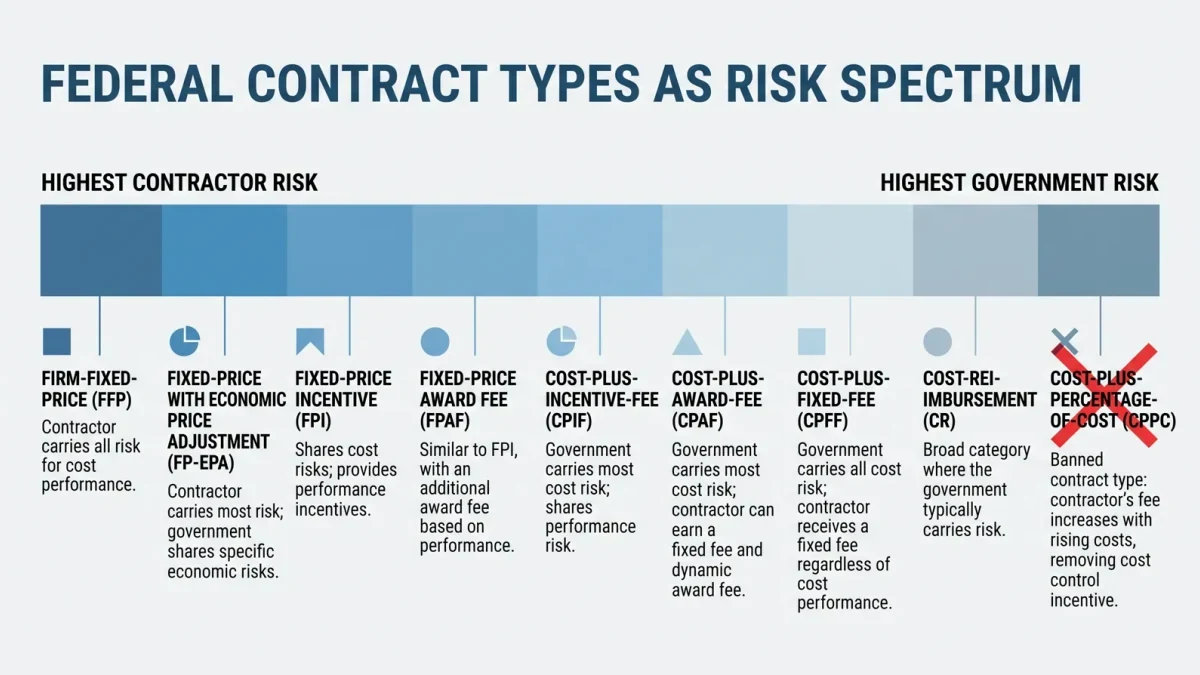
A firm fixed-price contract names one number: the contractor delivers the item for that price, keeps any savings, eats any overrun, and carries profit or loss depending on execution. A cost-plus-fixed-fee contract reimburses allowable costs and adds a fee unrelated to performance; a cost-plus-incentive-fee variant ties the fee to how actual costs compare with a negotiated target. Between the poles sit fixed-price incentive contracts, which share costs above and below target in agreed proportions, and fixed-price contracts with award fees tied to performance evaluation.
| Firm fixed price | Fixed-price incentive | Cost plus fixed fee | |
|---|---|---|---|
| Overrun borne by | Contractor | Shared by formula | Government |
| Best suited for | Mature production, clear specs | Moderate uncertainty | Development, research |
| Contractor incentive | Maximum cost control | Hit the target cost | Little cost discipline |
| Typical failure | Losses, exits, quality shortcuts | Target missed, both pay | Cost growth without a brake |
The table compresses the policy trade. Fixed price buys the government a predictable number at the price of transferring risk to whoever is least able to price it; cost-type terms buy honesty about unknowns at the price of removing the contractor's financial brake.
Why is development work usually cost-plus?
Because nobody can price a prototype honestly. Development attempts to build something that has never existed, and its cost distribution has a long tail of unknowns — a material that fails qualification, an integration problem that reshapes the design. A contractor asked to fix a price on that distribution must either load the price with contingency, making the bid unaffordable, or bid thin and accept a coin flip. Defense acquisition policy since the 1960s has drawn the line accordingly: cost-reimbursement for development, fixed price for production of a known article at known rates.
FAR Part 16 states the principle explicitly — the contract type should match the degree of uncertainty, and risk should sit with the party better able to manage it. The B-21 case is instructive precisely because it deviates: the engineering and manufacturing development contract was structured largely fixed-price, which defense officials defended as discipline but which produced the Northrop charges disclosed in 2022 and 2023. Both readings can be true at once — the structure imposed discipline, and the contractor paid for the uncertainty the structure pretended did not exist.
What do fixed-price failures look like in the record?
The KC-46 is the largest documented case. Boeing won the tanker in 2011 on a firm fixed-price development contract, a structure it accepted to win the franchise, and has since disclosed more than $7 billion in charges as military certification of the tanker's systems — boom, cameras, fuel systems — ran far past the estimate. The Air Force received its aircraft, but the record shows the second-order costs: contractors absorbed losses, delivered work under pressure, and the government spent years managing schedule shortfalls and aircraft it could not fully use in assigned missions.
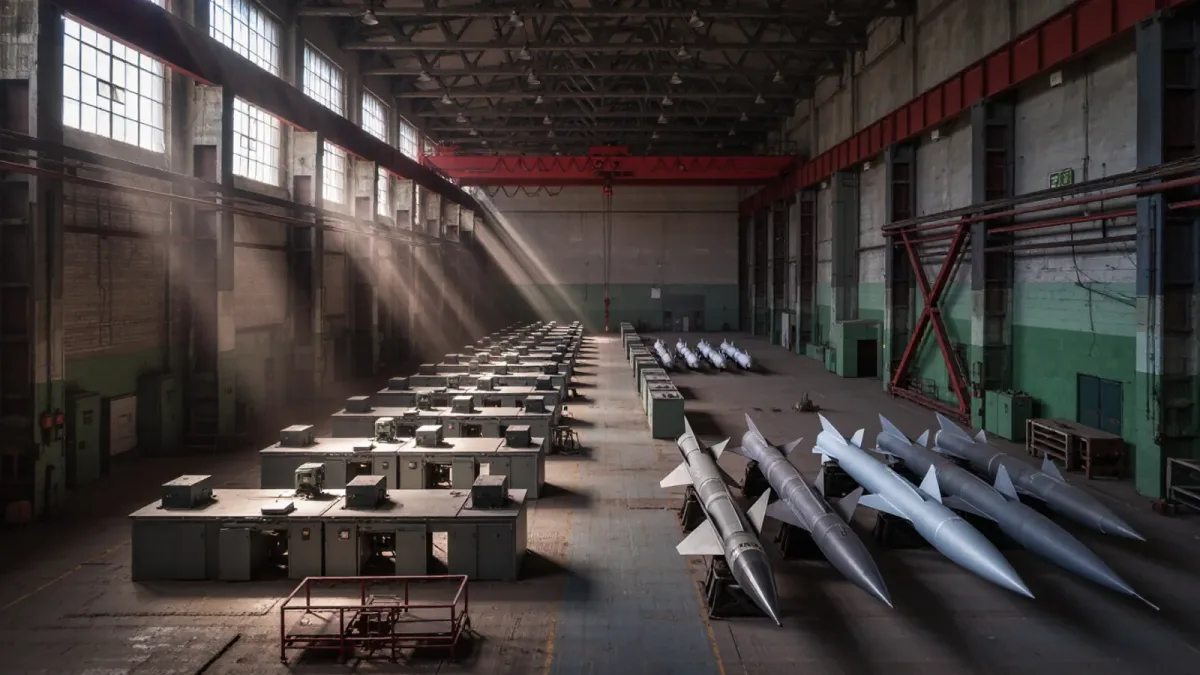
The documented failure modes cluster into three patterns. First, contractor losses push bidders out of fixed-price development competitions entirely, shrinking the future industrial base — a dynamic DoD leadership has publicly acknowledged. Second, a contractor fighting losses has documented incentives to cut corners or renegotiate through concurrency disputes, which oversight bodies then must police. Third, the government is never fully protected: when a fixed-price program collapses, the taxpayer absorbs the schedule slip, the capability gap and often a renegotiated follow-on, even if the overrun itself stays on the contractor's books.
How does the government decide which type to use?
The decision is documented in the acquisition strategy and litigated in source selection. Cost analysis weighs the maturity of the design, the stability of requirements, the contractor's cost history on comparable work, and the audited estimating systems behind the bid. DoD policy since the early 2010s has pushed fixed price where requirements are stable and cost-plus where they are not, and GAO reviews have repeatedly urged the department to match structure to uncertainty rather than to political messaging about discipline.
Two complications recur. Concurrency — producing while testing — smuggles development uncertainty into nominally stable production lots, and several GAO major-weapon reviews have flagged it as the standard mechanism by which production programs grow costs anyway. And escalation clauses, which adjust fixed prices for raw material inflation, were invoked widely after 2021 supply-chain disruption, showing that a fixed price is fixed only in the dimensions the contract chose not to index.
So who really carries the risk?
In the long run, the taxpayer carries most of it, whichever label sits on the contract. A contractor that absorbs a $7 billion loss does not repeat the mistake — it demands cost-plus or inflated fixed prices next time, refuses development competitions, or exits the sector, and the government's next solicitation prices in the scar. Fixed price genuinely transfers risk for one program cycle on a mature design; across decades, the documented pattern is that risk re-emerges as higher prices, fewer bidders and lost schedule. The contract type decides who pays first, not who pays finally. That is the whole trade.