An air policing mission is a standing peacetime arrangement in which one country's fighters, controlled by another country's radar, maintain 24-hour quick reaction alert over airspace that belongs to neither — and its core statistic is not a number of kills but a calendar. NATO's Baltic Air Policing mission has run continuously since 29 March 2004, when the alliance took on the defense of the airspace of Lithuania, Latvia and Estonia, three members with no fighter fleet of their own.
The mechanism matters more than the headline. This is not a combat air patrol waiting for a war. It is a legal and procedural scaffolding that keeps interceptors parked, fueled and crews rested so that an unidentified transponder-less contact over allied territory meets a four-ship of armed fighters within minutes, on any given Tuesday, for decades.
Why do some allies need policing at all?
Because airspace sovereignty and fighter fleets are separate purchases. Iceland dissolved its armed forces decades ago and joined NATO in 1949 without ever operating fighters; Luxembourg, Slovenia and Albania operate none or minimal ones; the Baltic states bought sovereignty in 2004 without buying air superiority aircraft. NATO's founding logic treats collective airspace as one problem. Article 5 gets the headlines, but the quieter bargain is that each ally contributes what it can, and surveillance-plus-interceptors over undefended sectors are a shared service — the alliance's own publications describe it as a peacetime collective defense task, not a contingency plan.
The deployments read like a relief roster. In the Baltic, detachments have come from the United States, the United Kingdom, France, Spain, Portugal, Italy, Germany, Poland, the Czech Republic, Denmark, the Netherlands, Belgium, Hungary, Romania and others, typically on four-month rotations from Šiauliai in Lithuania and Ämari in Estonia. Iceland's peacetime mission, running since 2008, works differently: with no basing of permanent fighters, allied jets deploy periodically to Keflavík and fly alerts from there.
What does a quick reaction alert actually involve?
A QRA detachment keeps a specified number of armed aircraft at immediate readiness, with crews sleeping or working within sprint distance of the jets. NATO practice at Baltic Air Policing has historically held four aircraft on the detachment; after Russia's 2014 annexation of Crimea, the alliance doubled the Baltic presence to eight aircraft per rotation, per NATO announcements at the time. The scramble chain is simple to describe and drilled to the second:
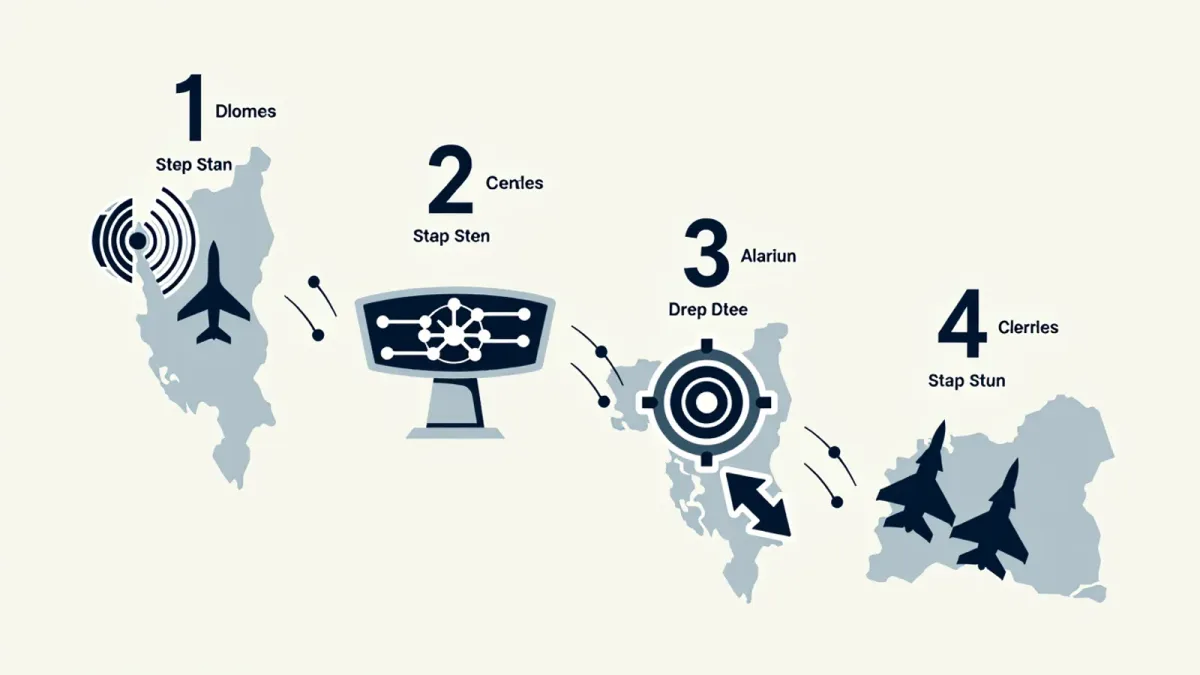
- A NATO or national control and reporting center tracks an aircraft with no flight plan or no transponder contact — in the Baltic region, Russian military traffic flying international airspace between the mainland and Kaliningrad is the routine case.
- The center's commander decides whether the track warrants a scramble. Most do not; identification flights are the exception, not the rule.
- Alert fighters launch, usually two-ship, and close visually.
- The flight leader identifies the aircraft type, registration and behavior, then either shadows it until it departs or hands it to the next authority.
NATO has stated in annual releases that allied fighters in the region scramble on the order of a few hundred times a year in busy periods, most flights involving Russian military aircraft transiting the Baltic — the alliance's figures are the attributed source here, and yearly totals vary. Publicly available sources do not establish a single stable annual number, so treat any specific figure with a year attached, or skip it.
Is anyone actually expecting an attack?
No — and that is the point of the mission's design. Air policing exists for ambiguity, not invasion. The routine cases are lost transponders, civilian emergencies, and Russian military flights that are legal under international law but unnerving at close range. The intercept resolves ambiguity with a visual report: aircraft type, weapons load if visible, behavior. A 2023-style year of high tension changes the traffic count, not the drill. NATO marked twenty uninterrupted years of Baltic Air Policing in 2024, a milestone the alliance noted with a ceremony at Šiauliai rather than a change in alert procedures — continuity is the deliverable.
The drill also runs in both directions. Contributing air forces treat the rotations as training currency — live intercepts of real foreign military traffic over water are experience no simulator reproduces — which is one reason rotation slots are oversubscribed among allies seeking flying hours against a genuine target set.
The honest reading of the mission's threat model is that it prices in accidents and miscalculation. An unarmed transport with a dead transponder heading toward populated Baltic airspace at flight level 300 is exactly the case the four-minute sprint exists to resolve.
What does the mission cost, and who pays?
The contributing nation pays for its own detachment; the host nation provides infrastructure; NATO coordinates through its integrated air and missile defense system and the Combined Air Operations Centers, including CAOC Uedem in Germany for the northern flank. Per-unit figures for a rotation are not published in consolidated form, though contributing governments occasionally release national costs. Publicly available sources do not establish a comparable alliance-wide cost figure, and this piece will not invent one. What is public is the structure: the mission is deliberately modular, so a rotation can be strengthened — as in 2014 and again after 2022 — without renegotiating the framework.
How has the mission changed since 2022?
Scale, not substance. After February 2022 NATO reinforced eastern flank air policing with additional deployments in member states bordering Ukraine and Russia, and at the July 2023 Vilnius summit the alliance's public statements emphasized moving from deterrence by reinforcement toward a longer-term posture. The alert drill, the identification procedure and the legal basis are unchanged from 2004; what changed is the tempo of the air traffic the drill is applied to, and the number of allies volunteering for rotations. Sweden's accession in March 2024, per NATO announcements, added another Baltic perimeter state to the integrated air defense picture.
That is the whole trade of air policing: years of nothing, resolved in minutes, over and over. The mission's success is measurable only in its own absence of incident, which is why it stays out of the news until something goes wrong — or until an anniversary reminds readers it has been running the whole time.