Base protection is a layered rings problem: push the threat away with standoff distance, detect it at the perimeter with sensors, hold it with quick reaction forces, and shoot down what still gets through with terminal defenses — and the entire design lives in the seams between those rings. The US Department of Defense formalized the approach in its Unified Facilities Criteria series, where the minimum antiterrorism standards for buildings, UFC 4-010-01, prescribe standoff distances and construction hardening as engineering requirements, not suggestions.
The subject deserves more attention than it gets, because base protection is where air defense doctrine becomes civil engineering. A modern expeditionary airfield is a concentration of fuel, munitions, aircraft worth tens of millions of dollars each, and thousands of personnel inside a boundary that may be several kilometers long — defended against threats that range from a single attacker with a rifle to a ballistic missile arriving at speeds no fence addresses.
Why does standoff distance come before everything else?
Because distance is free protection that never misses. The DoD standards in UFC 4-010-01 assign minimum standoff distances between potential explosive locations and inhabited buildings, with the distances set by explosive weight and building construction class. Every meter of standoff reduces blast pressure on structures and buys reaction time for the human layers behind it. Airfield geometry follows the same logic: munitions storage areas are built far from flight lines, and fuel farms are separated from both, per the same criteria family that governs DoD construction.
Standoff also defines what the perimeter is for. On a large installation the fence line is not the defended line — it is a detection line placed as far out as terrain, budget and host nation agreements allow, so that everything inside has time to respond. When a base is forced to draw its perimeter in, as forward operating locations in confined terrain must, the engineering standards force compensations: hardened construction, blast-resistant glazing, and internal barriers that recreate standoff artificially.
What does the perimeter layer actually consist of?
The fence is the least of it. A functioning perimeter is a sensor system that happens to have a fence. The standard construct, visible in DoD security engineering guidance and Army physical security publications, stacks four functions:
- Detection. Buried seismic and magnetic sensors, microwave and infrared trip beams, radar ground-surveillance systems that cover cleared strips, and increasingly towers with cameras and small radar. Detection at distance is the whole currency — every second between detection and contact multiplies the value of everything downstream.
- Assessment. Cameras and patrols confirm whether a detection is an animal, a sensor fault or a person. False alarm rate is the hidden specification; a perimeter that cries wolf teaches its own guards to ignore it.
- Delay. Barriers, wire, vehicle ditches and locked gates designed to slow a determined intruder long enough for the response force to arrive. Delay without response is decoration.
- Response. The quick reaction force, drilled against clock requirements, plus a Base Defense Operations Center that fuses sensor inputs into a single picture.
The BDOC is the actual defensive weapon. Its effectiveness is measured in the time from first detection to assessed contact to reaction — a figure bases track in exercises, though specific performance numbers are not published in consolidated form. Publicly available sources do not establish typical detection-to-response times for specific installations, and this piece will not invent them.
What is point defense, and what does it protect?
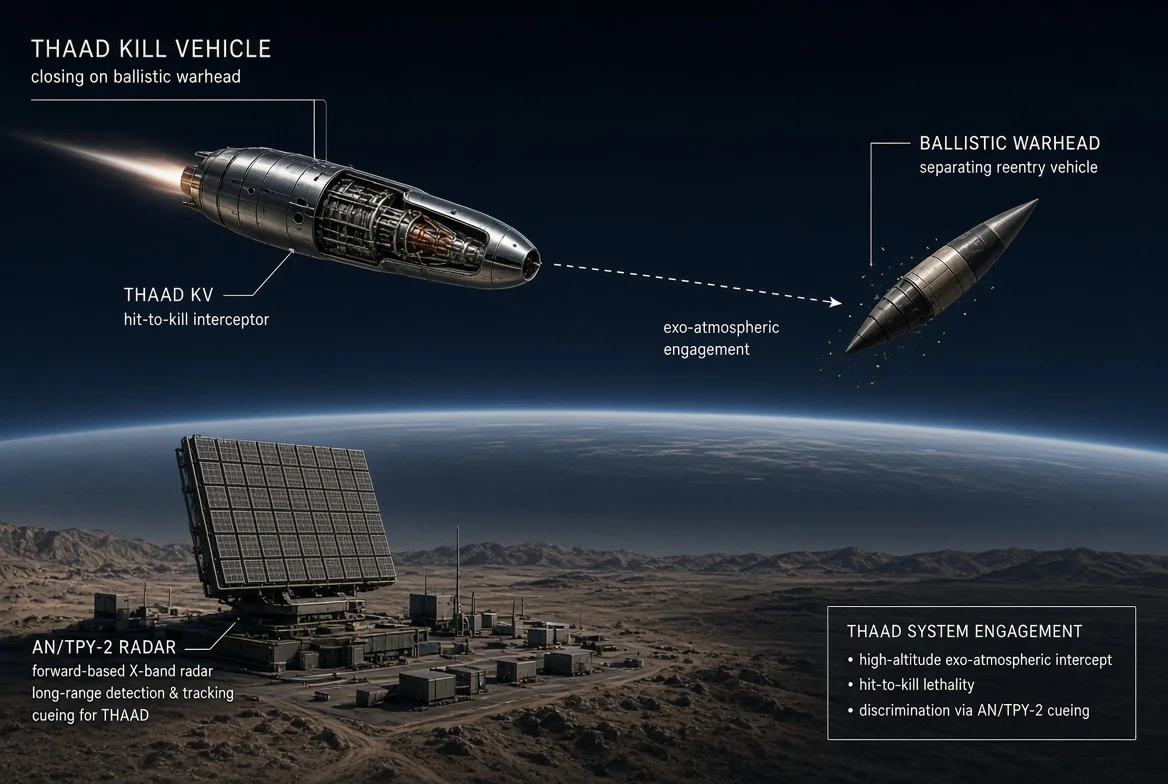
Point defense is the terminal ring: weapons that engage threats in the last seconds over a specific asset, rather than the wide-area systems that work at altitude and range. On a defended air base the point defense tier covers the flight line, the munitions area and command facilities. Its canonical counter-rocket example is the C-RAM system the US Army fielded in Iraq in 2005, per Army statements — a land-based configuration combining radar detection of incoming rockets, mortars and artillery with a rapid-fire interceptor and warning systems that cue personnel to cover. The Army has publicly credited C-RAM with protecting personnel in theater; specific intercept percentages in combat are operator claims and hard to verify independently.
Short-range air defense systems — man-portable and vehicle-mounted — sit in the same tier, engaging aircraft, helicopters and increasingly the small drone threat that has dominated base-protection discussion since 2019. The rise of commercial quadcopters has forced the fastest evolution in the field: a fence and a machine gun do nothing against a two-kilogram aircraft dropping a grenade, and installations have layered jammers, gun solutions and drone-specific sensors onto legacy structures, per widely published US and allied counter-drone programs.
Where are the gaps in between the rings?
The design gaps are known and engineered against, but three persist as structural problems. The underground and indirect problem: tunnels, and threats that bypass the perimeter entirely — an insider, a supply truck, a mortar fired from beyond the fence into the flight line. Mortars historically defeated perimeter logic, which is exactly why C-RAM and counter-battery radar entered the base defense stack. The magazine problem: terminal defenses consume interceptors at ratios favoring the attacker; a base defending against sustained drone salvos expends expensive munitions against cheap ones, the cost-exchange problem again, now at the fence line. The integration problem: a perimeter run by security forces, an air picture run by air defenders and a counter-drone cell run by a third chain can each work while the seams leak — which is why DoD counter-small-drone doctrine since 2020 has emphasized a single command node per installation.
There is also a budgetary gap: permanent main operating bases in secure countries can defer these layers for decades, then inherit the cost all at once when threat conditions change. The 2019-2020 drone incidents at US installations in Syria, widely reported at the time, were the visible version of that deferred bill.
How does threat level change the whole design?
Through the Force Protection Condition system, the DoD's graded set of protective measures that tightens every layer simultaneously as threat rises. At the lower conditions a base runs routine patrols and normal access control; at the higher conditions, gates thin to minimum entries, barriers and vehicles stage at entrances, guards double, and alert postures push detection assets outward. The system, defined in DoD force protection guidance, is the connective tissue between the engineering layers and the daily routine: the same fence, sensors and QRF are worked harder or lighter depending on which condition the installation commander sets. Readers can often see the condition in public reporting on installations abroad, because the visible measures — vehicle inspections, restricted access — are its exterior signature. The design insight is that base protection scales by procedure before it scales by construction; concrete is the last adjustment, procedure the first.
How is a base protection design actually tested?
Through exercises that stress the clocks. Red-team penetrations, simulated mortar attacks and drone raids are run against the BDOC's detection-to-response timeline, and the results drive sensor placement and barrier budgets for the following cycle. US Army and Air Force publications describe this assess-and-adjust loop as continuous; exercise results themselves are not published in detail. A reader can still evaluate a base protection story from public evidence: check whether sensor towers, cleared strips and radar appear in construction awards; check whether quick reaction forces are budgeted as standing units or borrowed; and check which threat the newest additions address, because that tells you what the designers fear most.
Weapons choices reveal the same scaling logic. A ground commander who fears vehicles requests barriers and anti-tank weapons; one who fears rockets requests radar and interceptors; one who fears drones requests jammers first, because jamming is the only layer whose magazine never empties. Published US and allied counter-drone guidance since 2020 has leaned heavily on that ordering — detect and defeat at the electronic layer before expending kinetic rounds — and the same triage now shapes base protection budgets across NATO. The reader who wants to know what a base fears can simply watch which defensive contracts it signs next.
That is the whole trade. Base protection is not a wall; it is a clock, and every layer from standoff distance to the last interceptor exists to spend the defender time the attacker cannot afford.