A defense white paper is a government's account of threats seen and spending intended — every line survived a disclosure fight. When Japan's Cabinet adopted its National Security Strategy on December 16, 2022, it committed to defense spending of 2 percent of GDP by fiscal 2027, per the Cabinet Secretariat — a number meant to be read in many capitals.
What follows is how that public text gets made: who writes it, who reviews it, and what disappears on the way to the shelf.
What is a defense white paper actually for?
A white paper is a policy document, not a law and not a budget. It serves four audiences that want different things: a parliament that votes the money, an industry that plans production lines, allies who want written reassurance, and adversaries who are expected to read it as a signal. A useful white paper is written for all four at once, which is why the drafting takes months and the arguments are rarely visible.
The transparency is itself the strategy. Publishing a target — 2 percent of GDP by fiscal 2027, in Japan's case — turns a plan into a commitment that allies can price, domestic critics can measure, and historians can audit. That forcing function is the point of publishing at all. It is also why governments rarely publish numbers they intend to miss.
Who decides what goes in?
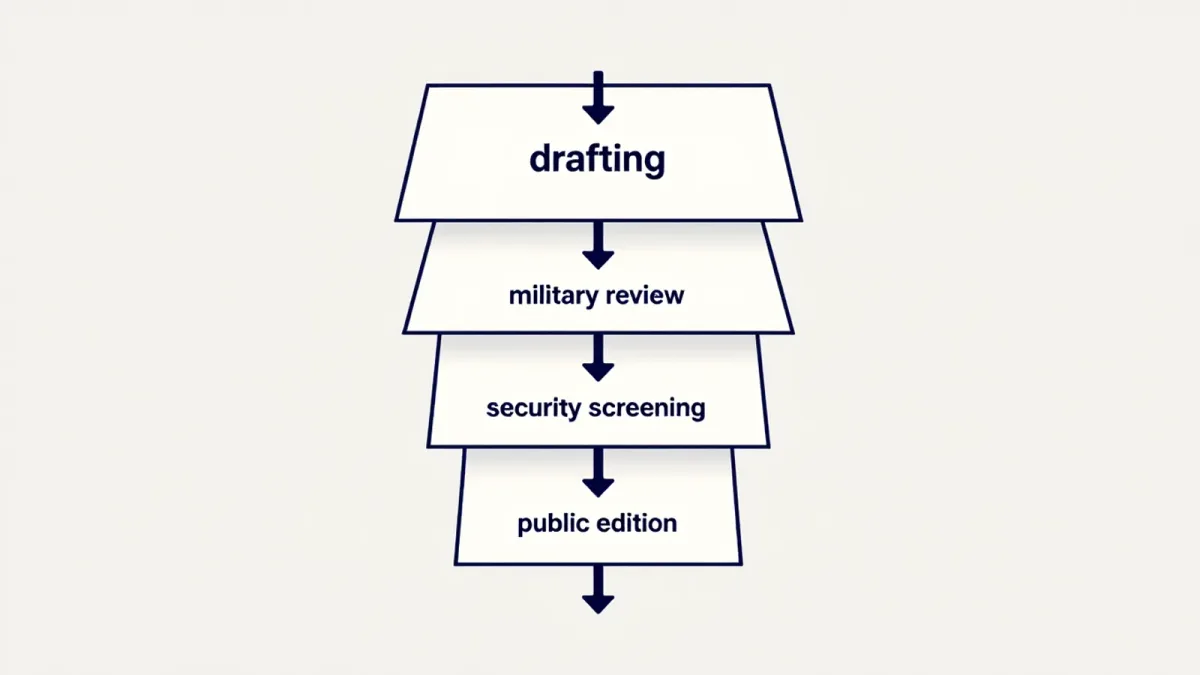
The machinery varies by country, but the sequence rhymes. Ministry drafting staff produce a first text; military planners insert capability language; national security or cabinet-level bodies reconcile it with foreign policy; and a classification review decides what the public edition may contain. Sign-off is political, which is why white papers appear at the moment a government wants the signal released — Japan's three strategy documents appeared together on December 16, 2022, for exactly that reason.
Publication practice differs in cadence more than in kind, as the table below shows. The format is shared; the rhythm is a national choice.
| Country | Publication habit | Documented example |
|---|---|---|
| Japan | Annual defense white paper, plus multi-year strategic documents | National Security Strategy, December 16, 2022 |
| China | State Council defense white papers since 1998 | 2019 defense white paper |
| Australia | Decade-scale white papers | 2016 Defence White Paper; 2023 National Defence statement |
| United States | Periodic National Defense Strategies instead of white papers | 2022 National Defense Strategy, published October 2022 |
Who actually reads a white paper at home?
Foreign ministries and adversary intelligence services get the attention, but the first reader is domestic. Parliamentary committees use the document as the government's own benchmark against which later budgets are graded; auditors mine it for commitments that can be tested; treasuries read it as an opening bid in the next spending negotiation. Industry reads it hardest of all, because a single sentence of intent — continued frigate production, a new ground-based air defense program — is a signal worth years of planning on an assembly line.
The domestic audience also explains the document's tone. A white paper must reassure without alarming, promise without overpromising, and justify money without sounding like a sales brochure. That balance is why the genre's prose is so carefully gray: each clause has usually been negotiated between at least three offices with different interests.
What gets held back before publication?
Three kinds of content routinely disappear on the way to the shelf. Specific performance figures — sensor ranges, readiness rates, magazine depths — are usually stated as intentions rather than numbers, or moved to classified annexes. Force details that would hand an adversary a target list, from unit locations to munition counts, are normalized into generalities. And awkward gaps — a program behind schedule, a recruiting shortfall — are softened into challenges the government is addressing.
Exactly where each government draws the line is itself not public: publicly available sources do not establish the internal disclosure criteria of most defense ministries. What is observable is the output — the public edition, and the classified annex that does not come with it.
Allies complicate the picture. A public edition may be paired with fuller classified versions shared with treaty partners, so that allied planners see capability detail the open text omits; disclosure therefore runs on two tracks at once, and the public document is best understood as the shortest of the versions in circulation.
How much is written for the adversary?
More than the plain text suggests. A published spending target announces that a buildout is funded and will not be cancelled after one budget cycle. A published doctrine sentence about striking launch sites, in general terms, tells an adversary what retaliation is now on the menu. Caveat applies: assessments of what a document really intends are interpretation, and readers of the same text in different capitals reliably disagree.
The reverse signal matters too. Silence about a capability can mean it does not exist — or that it does. Analysts who review white papers professionally treat omissions as data and treat their own inferences about them as unconfirmed.
Do announced plans match later budgets?
Only roughly, and the gap is itself information. Japan's fiscal 2023 national budget, approved in May 2023, carried the first large tranche of the 2022 buildup, per the government's own budget materials — an unusually fast conversion of white paper to money. More commonly, audit offices across several countries have documented years of slippage between published intentions and delivered forces. A white paper tells you what a government intends; the appropriations that follow tell you whether it meant it. Australia offers a documented case of the gap: the 2016 white paper promised twelve new submarines, and by 2023 the program had been restructured into the AUKUS pathway announced by the three governments in March 2023 — a strategic upgrade, but also a demonstration that a decade of white paper commitments can be rebuilt mid-course.
For readers of defense documents generally, white papers sit next to manufacturer datasheets in the evidence hierarchy: official, attributed, and written by a party with an interest in how they are read. Useful — never to be confused with verification.