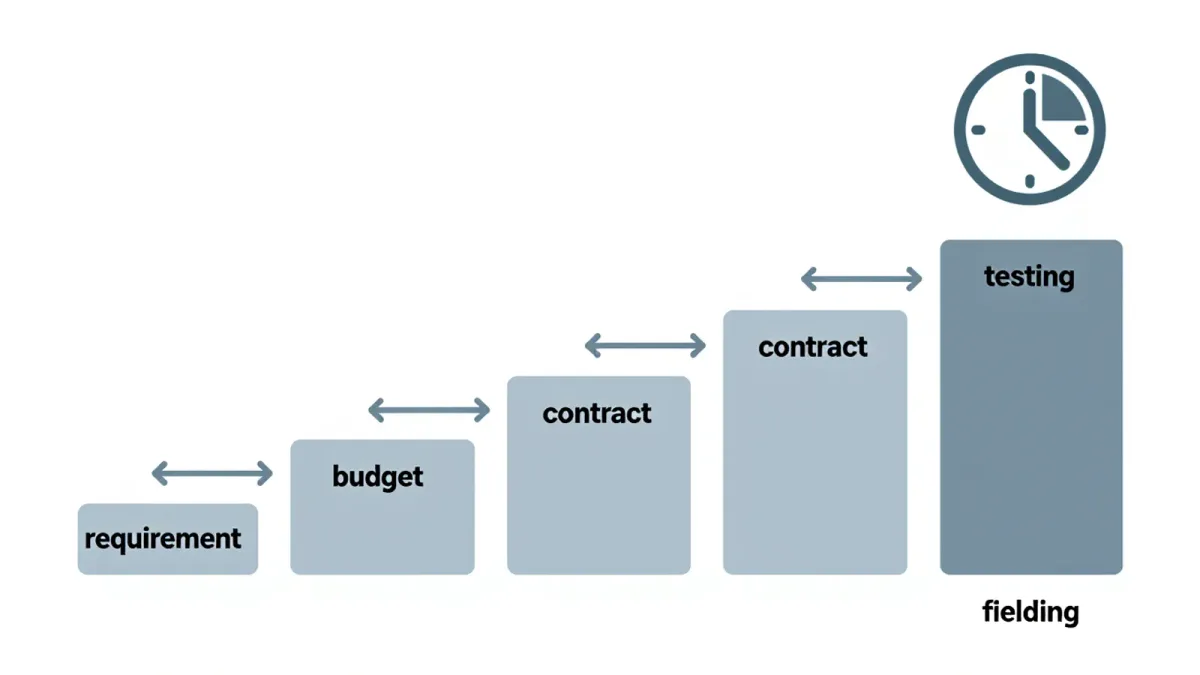
The federal government buys almost everything through a competition. Agencies write down what they want, companies answer in writing, a panel scores the answers against published rules, and the highest-value offer wins the contract. If a losing bidder believes the rules were applied badly, it can file a protest and force the agency to explain itself, sometimes redoing the whole contest.
This piece explains how that process works step by step: what a request for proposals actually asks for, how scoring rubrics turn prose into points, and why protests are a normal part of the system rather than a scandal. The legal foundation is old and simple. The Constitution is the supreme law of the United States and the source of all government powers, according to the White House, which means every federal contract ultimately rests on authority the Constitution grants and limits.
What is a request for proposals, and why does it matter so much?
A request for proposals, or RFP, is the document that starts a competition. It describes the work the agency needs done, the deadline for answers, the format the answer must follow, and — critically — the rules the evaluators will use to judge it. The RFP is the whole game in miniature. If a requirement is not in it, a bidder generally cannot win credit for offering it.
Agencies publish RFPs on public portals so any qualified company can see the same information at the same time. That openness is deliberate. The point is to let strangers compete fairly for public money, and the document does the work: it replaces relationships and phone calls with a fixed, written specification.
For defense work, the RFP often runs to hundreds of pages. It will specify not just the hardware or service but delivery schedules, security clearances, reporting duties and how past performance will be weighed. Companies spend months and real money writing answers, called proposals, before anyone knows who wins. This connects to our earlier piece, A Senate bill wants to fix how the Pentagon buys air and missile defense.
How do agencies actually score the bids?
Scoring is where the process gets concrete. The RFP lists evaluation factors, usually something like technical approach, past performance, price and small-business status, and states their relative importance. A source selection panel then reads each proposal and rates it against those factors using the rating scale the RFP published.
The key idea is best value, not lowest price. An agency may pay more for a proposal it judges technically stronger, as long as the extra cost is justified in the written record. Conversely, a cheap bid with a weak technical answer can lose on its merits. The evaluators must write down why.
That written record matters more than outsiders expect. The contracting officer builds a source selection document that ties every conclusion back to something a bidder actually wrote. If the record cannot support the decision, the decision is vulnerable. In effect, the scoring sheet is a legal document as much as a business one.
Two practical consequences follow. First, bidders tailor proposals to the published factors rather than to what they think is impressive. Second, agencies guard the process carefully, because a scoring step done off the published rubric is the most common way a competition falls apart later.
What happens when a losing bidder protests?
A protest is a formal challenge to an award decision. A disappointed bidder can take its complaint to the agency itself, to the Government Accountability Office, or to a federal claims court. The grounds are narrow and procedural: the evaluation ignored the RFP's own rules, the decision was not supported by the record, or the process was unfair in some documented way.
The reviewer does not pick the best product. It asks whether the agency followed its own published process and whether the record supports the outcome. If it finds a defect, the usual remedy is to require the agency to fix the evaluation or reopen the competition, not to hand the contract to the protester.
Protests are routine in defense contracting, where awards are large and margins between bidders are thin. Enthusiasts watching a program should read a protest the way they read a radar plot: it tells you where the program's uncertainty sits. A sustained protest can delay fielding by months, which is one reason acquisition timelines slip even when the technology is ready.
What this means for defense contractors and the air defense market
Our analysis: the contracting process shapes the defense industrial base as much as any budget line. A company that wins an RFP does not just get revenue; it gets a multi-year position in a program of record, with the factory investment that position justifies. A company that loses, or that gets protested out of an award, faces the opposite: capacity built for a program that did not arrive.
That is why procurement news and industrial news are the same story read from two ends. When Lockheed plans to triple Patriot interceptor output by 2030, the plan depends on orders placed through competitions and direct awards of exactly the kind described above, and on the parts suppliers those orders keep fed — a dynamic we followed in our piece on Lockheed's plan to triple Patriot interceptor output by 2030. Acquisition reform proposals, such as the Senate effort to change how the Pentagon buys air and missile defense, aim at this same machinery: they try to make the process faster without making it less fair, which we covered in our report on the Senate air and missile defense acquisition bill. Readers following this should also see Lockheed's plan to triple Patriot interceptor output by 2030 hinges on parts, not the assembly line.
The budget calendar sits upstream of all of it. Agencies can only run competitions for money Congress has provided or is expected to provide, and timing gaps in that funding ripple into when RFPs hit the street. Readers who want the upstream half of the story can start with how the government budget cycle works, deadline by deadline.
Where the process is strong, and where it strains
The strengths are real. Written requirements, published scoring rules and a protest right give every bidder, including small newcomers, a structured way to compete for public money. The record-keeping discipline makes favoritism harder, because a decision must survive a written explanation.
The strains are equally visible. Competitions take time, and time is scarce when threats move quickly. Proposals are expensive to write, which pushes smaller firms toward teaming with large primes rather than bidding alone. And protests, while legitimate, can be used strategically to buy delay.
None of these tensions has a clean fix; they are the cost of spending public money under public rules. What the evidence of the process itself establishes is that the winner of a government contract is rarely the company with the best product in the abstract. It is the company that best matched a published requirement, on paper, by a deadline, and whose award survived the challenge window. That is the whole trade.